Amid two consecutive years of graduate student admission drops and funding uncertainty, graduate students at the University of Wisconsin-Madison are staring down a precarious future in both their roles as researchers and undergraduate educators.
UW-Madison admitted 12% fewer graduate students in fall 2025 amid a 17% decline in federal research funding, campus departments implementing 5% budget reductions and possible student visa changes. The university admitted 12% more undergraduate students in fall 2025 than the previous year, but total enrollment has gone down 0.5%.
“We have long been a leading producer of PhDs. At this moment in time, it's worth asking whether more is necessarily better,” Provost John Zumbrunnen said in his public pitch to become UW-Madison’s academic leader in March. “There are big questions about PhD education to ask.”
Zumbrunnen said the university needed to step back and figure out the best path forward for graduate education.
“There are really important questions for us to ask, especially given the changing federal research funding landscape, about what the role of our students is, as students, as scholars, as employees in the research enterprise and as employees in the instructional enterprise,” Zumbrunnen said. “Can we step back? Can we momentarily decouple their role as students from their role as employees and ask what our strategy is for PhD education in the professional space?”
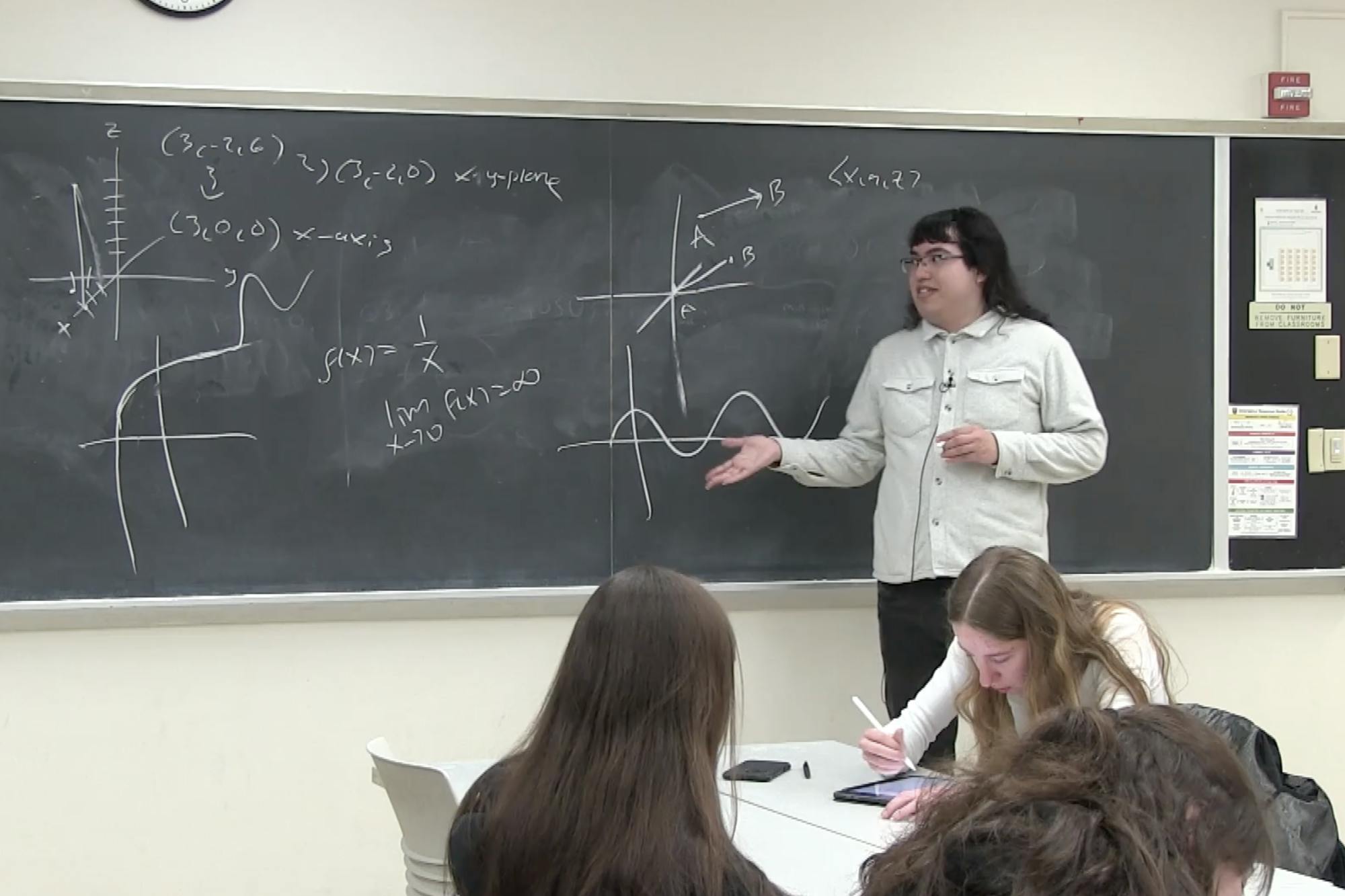
Gisel Flores, a math department TA and co-president of the Teaching Assistants Association (TAA), said budget cuts have hit the math department especially hard.
She said the department is working to avoid increasing class sizes, but other parts of the department are suffering from budget cuts — notably the Math Learning Center.
“Last semester, for the first time in recent memory, the Math Learning Center had to reduce its own hours, and this was because our institutional fund started to dry up, and there was just not enough money to support its hours,” Flores said. “Next year, the math department is expecting to get rid of most, if not all, of its hourly graders and also some of the undergraduate roles that sustain the Math Learning Center are going to be replaced by PhD students.”
The math department’s masters program utilizes a Service-Based Pricing model where the tuition students pay towards the graduate program goes directly back into the program’s Fund 131, which covers operational costs and program reinvestment.
As fewer students enroll and less money goes toward the fund, programs are left with a financial gap and could be forced to cut courses, TA positions and student services. As decreasing enrollment intersects with budget cuts, departments are expected to reduce spending without the additional cushion of tuition.
“Because international students are not enrolling as [consistently] as prior years, that means that this fund is literally drying up and because of that, a direct response to this [is] our department is no longer hiring postdocs,” Flores told the Cardinal.
As less teaching assistants are expected to step into more responsibilities, the impact will be felt in heavier workloads and larger discussion sections. For some School of Journalism and Mass Communication courses, one TA is responsible for approximately 100 students across multiple discussion sections. When serving as a TA last year, one SJMC graduate student told The Daily Cardinal they weren’t able to go home for Thanksgiving thanks to their “onerous workload.”
“I fear those types of anecdotes will become more and more common as there are less TAs per student,” they said.
Eric Hoyt, a professor in the Department of Communication Arts, told the Cardinal the university’s appointments for graduate students are as teaching assistants, and right now “there’s less money available for that, which makes it harder not only to recruit really good students but also pay them for their time and work.”
International enrollment has declined as the Trump administration changed how long visa holders can stay in the U.S. In [year], international students experienced more than three times the amount of visa delays as previous years and potential changes to F and J-1 visas.
Along with shorter visa terms, it’s becoming harder for graduate students to secure funding past their fifth year. Prior to the budget cuts, departments could only guarantee a certain number of years of funding, but they could also make stronger off-paper guarantees to help students secure additional funding. Flores told the Cardinal that a political science graduate student she met with told her all fifth-years were recently told funding was unstable.
“[The email basically said] ‘hey, we can’t guarantee you funding, you should look into ways of getting other sources of funding if possible,” Flores said.
On top of that, Flores said all academic department funding relies partly on undergraduate enrollment. With an incentive to get as many students in the classroom as possible, graduate students will be the ones to bear the brunt of the additional burden.
One major change prompted by the budget cuts will be how UW-Madison decides to disperse undergraduate tuition. Currently, undergraduate tuition is dispersed through a cost-follows-instruction model that sends 100% of undergraduate tuition money generated by a course directly back into that courses’ department. Starting this summer, only 60% of undergraduate tuition will continue to be dispersed that way, and the remaining 40% will be circulated back into the department of an individual’s major. Flores said for general education heavy departments like math, this puts a further strain on their budget.
“Math 112, college algebra, [for example], is a course that is primarily taken by nursing students. And so the tuition that these students generate for our department, these are the things that pay for our Math Learning Center. 40% of that is going to go to the nursing school instead of the math department,” Flores said. “Since these are the funds that sustain [things like] the Math Learning Center, we’re expecting a huge hit to what we can offer there.”
For other departments heavy with general education courses like Communication Arts and biology, Flores said the story is similar.
As UW-Madison implements the new framework, central campus will do a one-year hold harmless to compare its productivity against the current budget policy.
As graduate students face these budgetary challenges, the impacts are felt beyond the academic world. Flores said job security and health care are directly connected to budget cuts.
“These things are intrinsically linked, right? [Graduate student] job security is entirely dependent on whether our departments can uphold their funding guarantees,” Flores said. “The fact that we get health insurance at all when we have appointments like that [is great, but] contingent on us having an appointment to begin with.”
Photo editor Maggie Spinney contributed reporting to this story.
Editor's note: This story was updated on March 26 at 11:30 p.m. to correct that Hoyt is affiliated with the Communication Arts department not the SJMC.
.
.