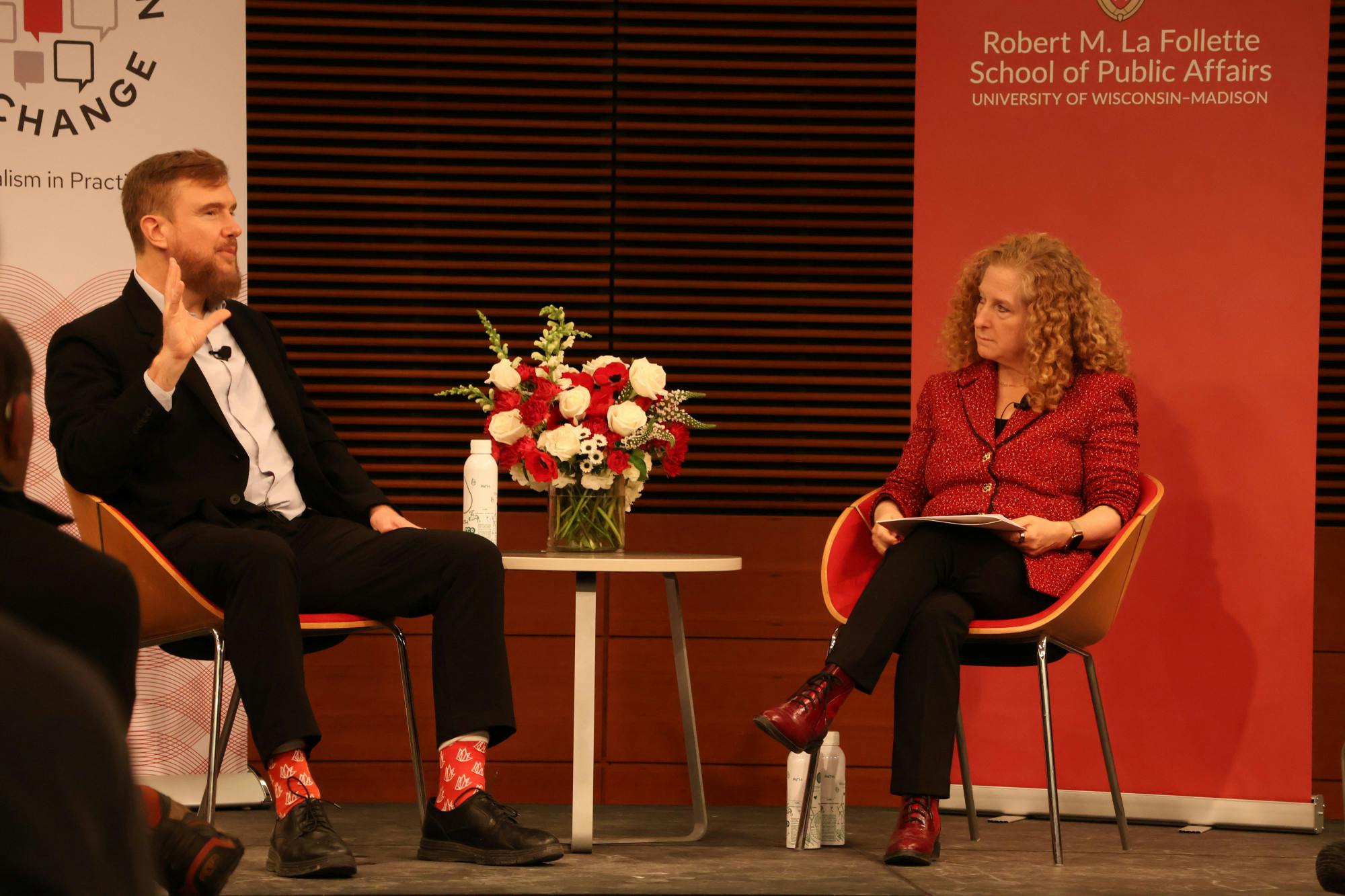
Greg Lukianoff, president and CEO of the Foundation for Individual Rights and Expression (FIRE), discussed campus free speech during a moderated conversation with Chancellor Jennifer Mnookin on Wednesday in the university’s second Wisconsin Exchange: Pluralism in Practice event.
FIRE is a civil liberties non-profit group whose mission is to “defend and sustain the individual rights of all Americans to free speech and free thought — the most essential qualities of liberty.”
Lukianoff and Mnookin discussed the idea of free speech “for me, but not for thee,” and scenarios and questions involving how structured friction and the heckler’s veto can affect college campus free speech.
The Wisconsin Exchange is a new campus initiative launched this semester aimed at promoting discourse and debate at the University of Wisconsin-Madison from across the ideological spectrum.
Mnookin kicked off the event talking about how hard it is to imagine “a more perfect place” to talk about free speech than Madison, a city named after James Madison, who enshrined freedom of speech in the U.S. Constitution.
“I think probably all of you are aware of the plaque on the front of Bascom Hall and its famous language with ‘fearless sifting and winnowing by which alone the truth can be found,’” Mnookin said. “That requires dialogue, inquiry, debate and being confronted with ideas we find disagreeable or offensive.”
She said that at the same time, universities need to be places where people can learn effectively, even with some “scaffolding.”
Mnookin spoke about how there is “an awful lot of free speech for me, but not for thee” and asked what “elevator pitch” Lukianoff uses to make people understand why free speech is so important, “especially when it's actually really uncomfortable.”
Lukianoff circled back to James Madison. “You can’t really have a democratic society if you can’t actually dissent, flat out,” he said. A member of FIRE’s advisory council, he recalled, explained the harm of punishing “bad” or “ignorant” opinions as a “poison gas.”
“You think you’re destroying your enemy with it, but then the wind changes direction, and it blows back at you.”
If you care about your own free speech, he said to the audience, you need to defend everyone else’s free speech.
In recent years, Lukianoff said FIRE has received more criticism, specifically from right-wing figures. He said it used to be more common to see threats to free speech from the left, but there has been a switch, with more attempts from right-wing politicians and pressure from the Trump administration to punish pro-Palestinian professors and students. He added that too much political homogeneity can harm the production of ideas.
Some universities, like Dartmouth, are currently trying to improve civil discourses on their campus and are trying to introduce “structured friction” to prevent students from thinking they cannot learn properly when being taught by someone who doesn’t share their same beliefs. Styles of teaching involving teachers who disagree on political topics teaching some of the same classes is a smart way to do this.
“It undermines that certainty that makes you sure you have nothing to learn from someone who disagrees with you and is toxic to an intellectual environment,” Lukianoff said.
Mnookin then brought up the increase in student interest for Deliberation Dinners at UW-Madison, where students converse and engage with each other on political issues. Mnookin said despite this and other pluralism initiatives, the university still received an F ranking from FIRE on free speech, which she called a “bummer.”
“I’m not saying there’s no more work to do here, there is,” she said, “but I also think we were doing a lot of work.”
FIRE currently ranks colleges on a scale of ‘free speech friendliness,’ using student survey data. However, the number one college on the list, Claremont McKenna College, still sits at a B grade, which Lukianoff said signals that every school can still do better.
Mnookin said FIRE subtracted points from UW-Madison’s score when protestors disrupted a campus talk by former United Nations ambassador Linda Thomas-Greenfield in April 2025. She said Thomas-Greenfield wanted to engage with the protestors, and that the protestors left when asked. Mnookin felt the situation was handled well, and asked why their rating was still ‘dinged.’
Lukianoff said there are levels to how many points they take off for disruptions. A university loses five for a violent disruption and three or four if the disruption cancelled the event. FIRE considered this a two point loss for UW-Madison.
One thing the two agreed on was that the “heckler’s veto” — when someone limits speech for a speaker by silencing them — shouldn’t be a form of protected free speech.
“You can’t incentivize a situation where students are acting violently, or for that matter, just illiberally, like shouting down a speaker, or saying, ‘We can’t shut this jerk down, but you can,’” Lukianoff said. “[This is] one of those things where you have to take a stand against that, or else it will happen all the time.”
Campus shout-downs happen more often than people think, he added, saying the idea that everyone is just expressing their opinion is not representative of the entire situation.
“You showed up and decided that, because I don’t like the speaker, none of you can hear this speaker,” Lukianoff said. “That’s an authoritarian impulse, that’s something that’s illegal, that is something that is not okay, and frankly, it’s one of the oldest forms of censorship that exists.”
He said students who engage in these shout-downs should be punished, but he makes it clear that a punishment should only be given when there is a clear distinction between speech and violence.
Mnookin and Lukianoff went on to say there needs to be reasonable “time, place and manner” restrictions on free speech.
“If someone stands up and starts booing that, you know, can you ask them to leave? Absolutely,” Lukianoff said. “And I feel like the same students who would say, we have free speech to just shut the speaker down would immediately understand it if it was a speaker they wanted to hear.”
Near the end of the conversation, Mnookin mentioned surveys showing students are anxious about social consequences of contributing to an environment around discourse and debate.
Lukaniaoff said universities should teach people how to make the best use of free speech and create environments where they can exercise the values of humility and curiosity. He continued, saying they should take advantage of getting people “more curious about each other, more curious about what their fellow students really think, and even if they hate what they really think, to be happy that they know what they really think, because that’s a more enlightened way to go about the world.”