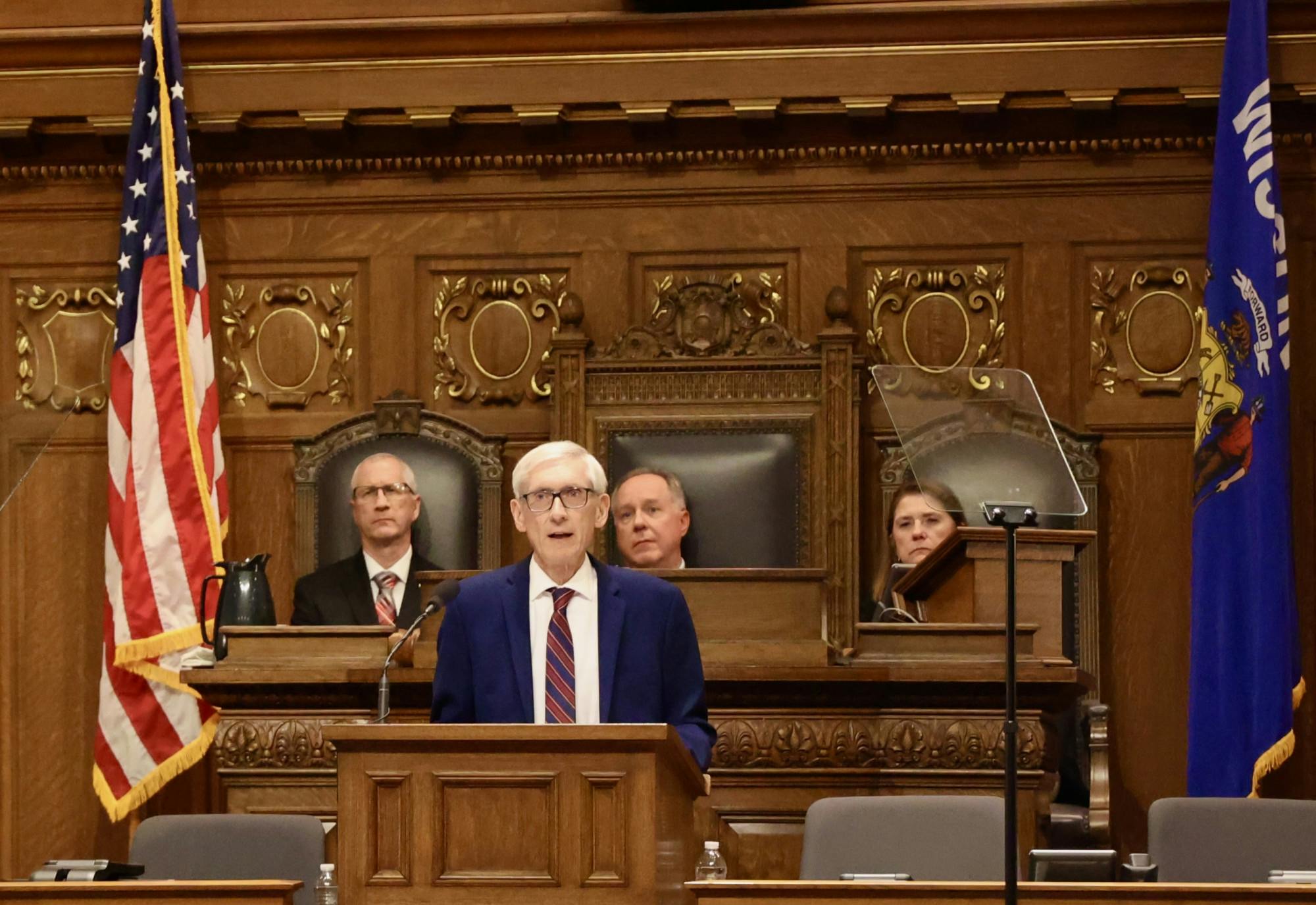
Gov. Tony Evers called for a special session of the Legislature on April 14 to consider a constitutional amendment which would ban partisan gerrymandering in Wisconsin.
Evers said he hopes to ban partisan gerrymandering permanently, after previously signing new legislative maps into law in 2024. Wisconsin had what experts considered to be some of the most gerrymandered districts in the country.
However, maps are redrawn every ten years, so the districts will be up for grabs again in 2030.
Because Wisconsin doesn’t have an independent districting commission, maps are drawn by the Legislature and passed in a bill-like process. Republicans have controlled both chambers of the Legislature since 2011 which allowed them to draw maps in their favor for more than a decade.
How was Evers able to pass fair maps with Republicans controlling both chambers?
Republican lawmakers said if the Legislature did not pass the governor's maps, they feared the liberal-controlled state Supreme Court would draw maps in favor of Democrats.
Justice Janet Protasiewicz won a seat on the Wisconsin Supreme Court in 2023, flipping the court’s ideology for the first time in 15 years. During her campaign, Protasiewicz called current maps “rigged” and “unfair.”
When Evers called Republican lawmakers in the past for special sessions, they often gavel in and out within seconds to avoid taking action. But University of Wisconsin-Madison political science Professor Barry Burden said this special session might have potential among Republicans.
Assembly Speaker Robin Vos, R-Rochester, already said he is willing to talk about ending gerrymandering with the governor. Still, Vos raised skepticism over the amendment because it is a single line change and does not include details on how it would ban partisan gerrymandering.
Burden said the amendment is more of an “idea of wanting to end partisan gerrymandering,” not necessarily about the process, adding that the amendment has to move through the legislature, campaigning and voter ballots before it could be approved.
“It's a long, complicated set of steps. But I think for the moment, it's still a live issue and has some potential,” Burden said.
How was Wisconsin gerrymandered?
Districts in the state were split up two ways: condensing highly populated areas and dividing suburbs among surrounding rural areas. This dampened the Democratic urban vote and bolstered rural, Republican-leaning areas.
A prominent example is Sheboygan, Wisconsin before Evers’ 2024 maps, where the city’s blue strongholds, compacted in its urban area along Lake Michigan, were cut in half and divided between districts 26 and 27. The rest of the district contained scattered red areas, which overtook the vote among that constituency.
Republican lawmakers gerrymandered the state in 2011 after taking control of the Capitol and electing Scott Walker as governor. The GOP eventually lost this trifecta after Evers narrowly beat Walker by just 30,000 votes in 2018.
Still, the gerrymandered maps persisted when the Legislature could not agree, leaving the Wisconsin Supreme Court to adopt districts with the least changes from the previous cycle, until Evers signed new maps into law in 2024.
What will this mean for the upcoming elections?
Democrats are looking to flip both the Senate and Assembly in November. They are more likely to win the Senate, as they only need to flip two seats to gain a majority, but they would need to flip five seats to control the Assembly.
With the new maps signed in 2024, Burden said Democrats have a chance at controlling the Legislature for the first time in over a decade. He also said with President Donald Trump's declining approval rating, Republicans would be “fortunate just to hold on to what they have.”
“Democrats have really not had a fair shot at winning either chamber for about 15 years,” Burden said. “But the combination of the new maps and having a favorable national environment, that's going to help Democrats out.”
If Evers’ constitutional amendment passes, Burden said Democrats would have a better chance to win elections in the future, like they do with the current maps. But if it does not pass, he said districts are ultimately up to whichever party controls the Legislature.
Audrey Lopez-Stane is the state news editor for The Daily Cardinal. She has written in-depth on free speech on campus, higher education and elections including the Wisconsin Supreme Court race and upcoming governor primary. Audrey previously interned at WisPolitics and now works for Wisconsin Watch. Follow her on X @ALopezStane.