University of Wisconsin-Madison leaders and students urged campus communities to strengthen civil dialogue, protect free expression and adopt a systemwide artificial intelligence vision responsibility at a Board of Regents meeting Thursday.
Outgoing UW-Madison Chancellor Jennifer Mnookin told regents UW-Madison has the responsibility to create environments where people can engage constructively across political and ideological differences, even when conversations are uncomfortable.
“We are in a polarized moment,” Mnookin said. “And yet it is incredibly important that universities remain places where people can test ideas, learn from one another and approach disagreement with curiosity rather than judgment.”
The Wisconsin Exchange, launched at UW-Madison last fall, seeks to teach political dialogue skills through classroom practices, student programs and public engagement. Students and faculty appearing before the board in a panel described the initiative as a response to rising polarization on campus and beyond.
Jackson Daniel, a junior who participated in Deliberation Dinners his freshman year and now interns for the program, said the small-group discussions bring students with differing viewpoints together for guided conversations designed to build understanding rather than consensus.
“I can disagree with someone without thinking they’re morally wrong or evil,” Daniel said.
Miranda Garcia Dove, co-founder of Bridge Madison, a student organization affiliated with BridgeUSA, said her group has hosted student-led discussions and bipartisan panels on topics including elections, health care and gender-affirming care. She said one of the biggest challenges is engaging students who feel their views are unwelcome or who avoid political spaces altogether.
Faculty members framed pluralism and free expression as central to the university’s mission.
Alex Tahk, a political science professor and director of the Tommy G. Thompson Center on Public Leadership, said universities cannot fulfill their role as truth-seeking institutions without openness to competing viewpoints.
Allison Prasch, an associate professor in the Department of Communication Arts, tied the Exchange to UW’s long-standing “sifting and winnowing” tradition, describing classroom strategies that expose students to multiple media narratives and encourage reflection on how beliefs are formed.
What’s next for AI?
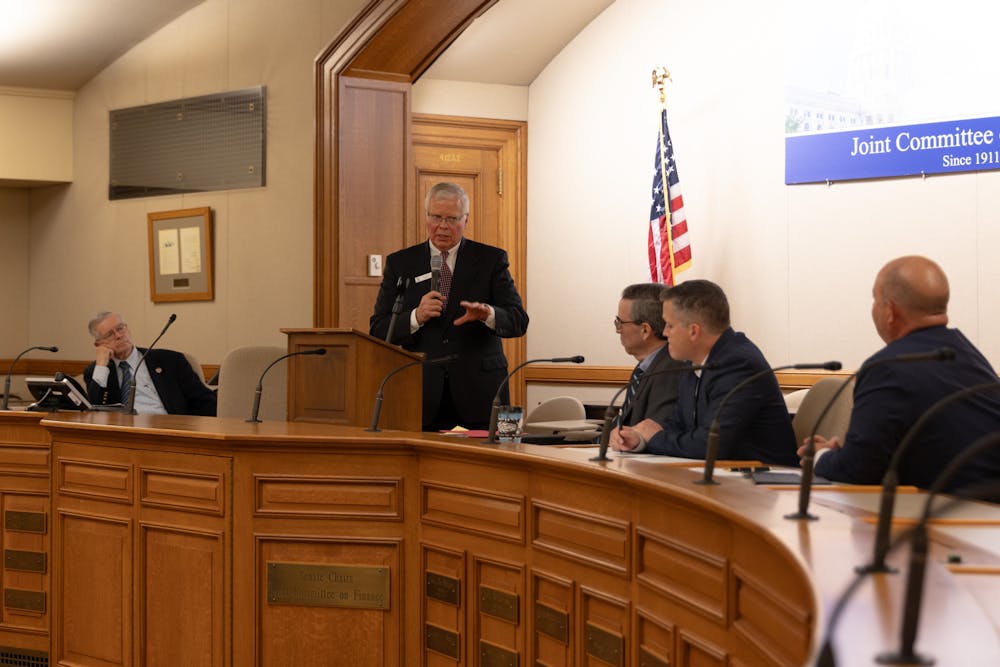
UW System President Jay Rothman outlined a systemwide strategy for AI, emphasizing that AI must complement — not replace — human judgment, mentorship and critical thinking.
Rothman identified six priorities guiding UW’s approach to AI, including using AI to support student success through advising and wraparound services; providing faculty with professional development and trusted AI tools; establishing an AI hub to coordinate procurement, research and compliance; improving operational efficiency while preserving human expertise; expanding AI literacy statewide and convening partners across business, innovation and workforce development.
“AI is not just a tool,” Rothman said. “It is reshaping how we teach and learn.”
Rothman said generative AI has the potential to personalize instruction, expand student support and free faculty to focus on deeper learning and mentorship. At the same time, officials cautioned that overreliance on AI could weaken critical thinking and creativity and raise concerns about privacy, bias, academic integrity and equitable access.
Kyle Cranmer, director of UW-Madison’s Data Science Institute, highlighted the UW-Madison’s Rise AI Initiative, which focuses on human-centered artificial intelligence and integrates research, teaching and public engagement. Cranmer said the initiative aims to position the university as a trusted partner for Wisconsin as AI reshapes the economy and workforce.
Examples of AI initiatives across the UW system included AI-based tutoring pilots at UW-Superior, manufacturing applications at UW-Stout, entrepreneurship efforts at UW-Stevens Point and ethics-focused AI coursework at UW-La Crosse.
Alaina Walsh is the editor-in-chief for The Daily Cardinal. She formally served as the associates news editor and as the city news editor. She has covered breaking news on city crimes, a variety of state and campus issues, the 2024 presidential election and the UW-Madison budget. You can follow her on twitter at @alaina_wal4347