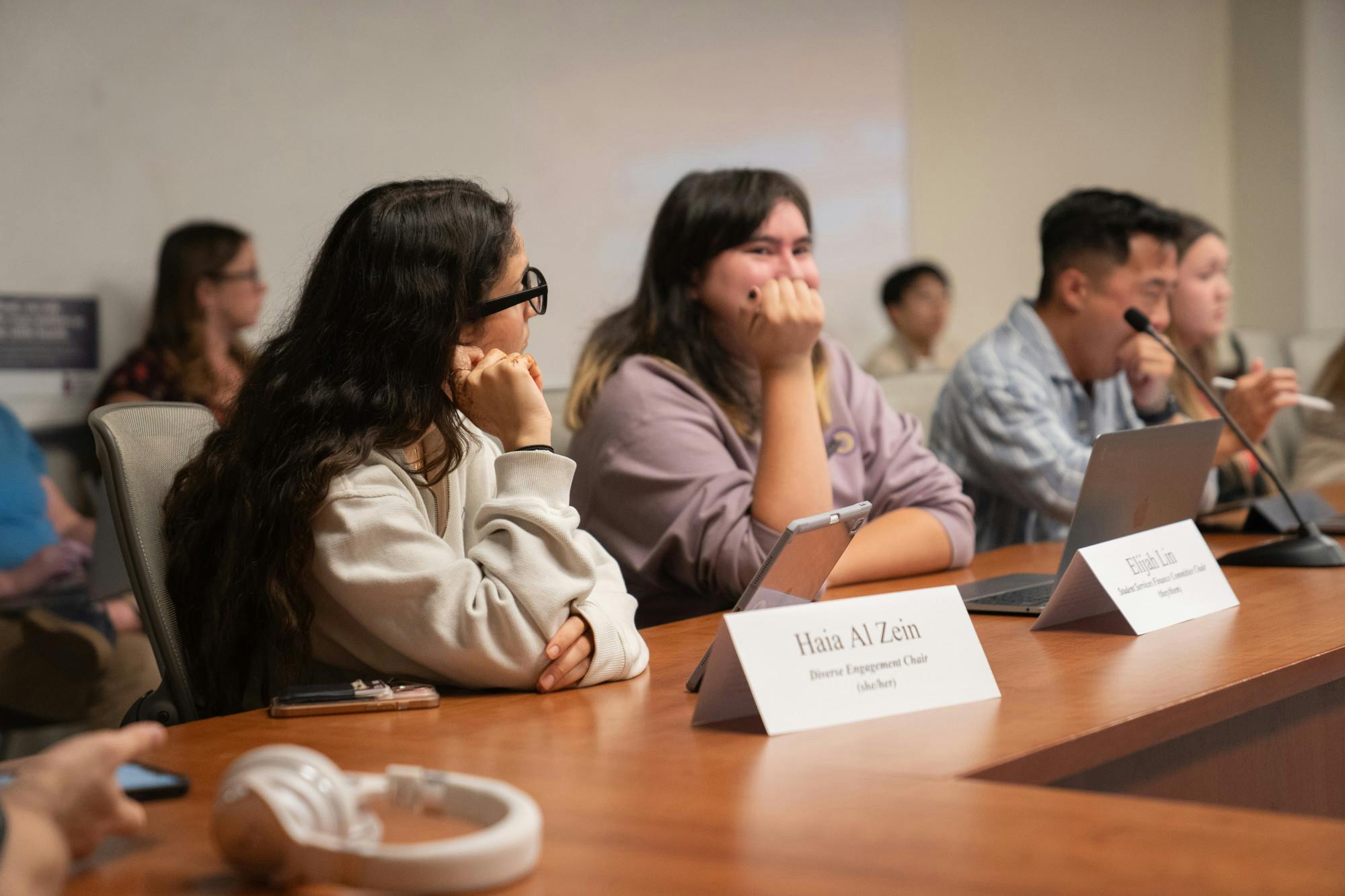
The Associated Students of Madison passed legislation to establish a formal committee to represent graduate and professional students at the University of Wisconsin-Madison, completing the first-round of votes necessary to approve the Graduate and Professional Committee at its Wednesday student council meeting.
There are 12,629 graduate and professional students at UW-Madison, making up nearly 24.4% of the total student population. At-large graduate student representative Elizabeth Anderson said she and her peers began to recognize differences between their needs and those of undergraduates, leading to the formation of a temporary ad-hoc committee last spring.
At a fall 2025 ASM meeting, Anderson brought forth several challenges graduate students face, including alterations in health insurance coverage when transitioning between teaching assistant roles and the difficulty of balancing school responsibilities with family life. She also raised concerns about the allocation of segregated fees, noting that international graduate student teaching assistants are required to enroll in a full-time, eight-credit load. Therefore, because full-time students are charged higher segregated fees, international students disproportionately face these increased costs.
However, international graduate student teachers assistants are considered full time at six or four credits, depending on their appointment percentages, which is the same as domestic students holding TA or PA appointments.
The group met numerous times between the spring and fall semester, focusing on formulating ideas to resolve graduate student concerns, which eventually led to their desire to formalize the committee.
Anderson said one of the challenges of operating as an ad hoc committee was the inability to formally meet or work over the summer. Creating an official committee gives the group an opportunity to function in the summer, while also providing a chair position to give input on legislation alongside other ASM committees.
While the committee would be centered on graduate and professional student issues, Anderson said she wouldn’t discourage undergraduates from joining.
“I think you can represent someone without necessarily being part of that demographic sometimes,” Anderson said.
Ethan Jackowski, a Student Services Finance Committee representative, explained the distinct differences between undergraduate and graduate student experiences, emphasizing his support for the committee.
“This is something that is very powerful, because there's a lot of times when we've had debate or conversation and someone will be like, ‘well, it's different for grad students,’ and I’m like ‘oh my God, I didn’t even think about grad students,” Jackowski, said. “I forget how different their experiences on this campus are.”
Co-sponsor Andrea Cristina Ruiz, a SSFC representative, expressed appreciation for the attention toward graduate students’ needs and contributions to the university, including grading and other educational responsibilities.
“It's been such an honor to serve on SSFC and meet other people and learn what undergrad life is like, and also share what grad student life is,” Ruiz said. “With those perspectives, I just hope that you will support this bill and representative Elizabeth's initiative to have a unique space where the grad students’ issues can be discussed, shared and hopefully advanced.”
Co-sponsor Cherish Golden, a third-year PhD student, noted her involvement in multiple committees, one of which now conflicts with a class of hers. She said formalizing the Graduate and Professional Committee would allow it to become her “main committee.”
“I think it's important that this committee be official, just because graduating professional students have very unique obligations related to teaching research classes work that really, really needed to be advocated for,” Golden told The Daily Cardinal. “I think it's important for people who do have the time and capacity and means to step up and serve to be that voice for their fellow students.”
ASM also approved two more Student Judiciary General Council agents, increasing the total to five. While both representative Michael Harry and ASM Chair Landis Varughese said this addition shouldn’t affect the budget, Varughese said ASM “reserves the right to amend the internal budget,” if necessary.
Both legislations passed, but as they’re bylaw changes, they will require two votes at two separate meetings.
Editors note: This story was updated at 2:42 to had further context on voting
Zoey Elwood is the college news editor for The Daily Cardinal. She previously served as copy chief. As a staff writer, she's written in-depth on state and local budgets, protest coverage and Wisconsin politics. She has also written for state and city news. Follow her on X at @zoeyelwood.