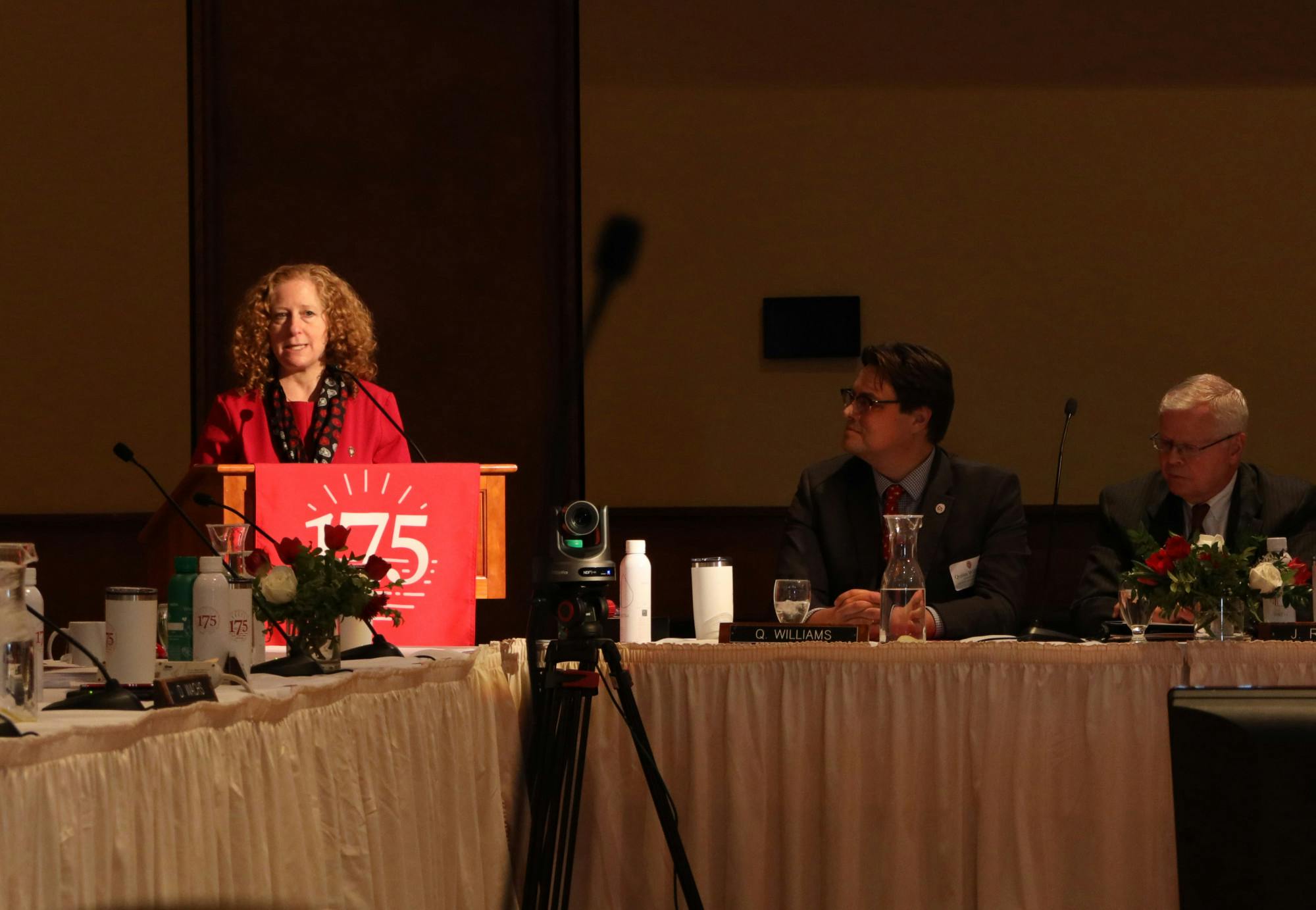
In her final appearance before the Board of Regents on Thursday, outgoing University of Wisconsin-Madison Chancellor Jennifer Mnookin delivered a reflective defense of public higher education, urging leaders to hold fast to core values while navigating an era of "profound uncertainty."
Mnookin, who will depart this spring to lead Columbia University, used her final report to frame her tenure not through the lens of individual achievement, but through a philosophy she termed "principled pragmatism," a blend of willingness to listen to critics while still maintaining a strong commitment to the university’s core values.
In the expansive, near hour-long address, Mnookin framed her tenure not merely as a series of administrative wins, but as a high-stakes effort to keep the state’s flagship anchored to its core values while radically accelerating its pace to meet a changing world.
"In moments of great disruption like the one we’re in, a significant measure of our leadership will be our ability to stay anchored to these core values while also being flexible enough to change," Mnookin said. "And change is needed."
She defined those anchors as academic freedom, research excellence and a commitment to pluralism — which she defined as the robust exchange of ideas across different backgrounds and viewpoints.
At the heart of Mnookin’s vision for a modern research university is the Research, Innovation and Scholarly Excellence (RISE) initiative. Designed to move the university beyond traditional departmental "silos," RISE has acted as a catalyst for interdisciplinary growth.
The university hired 133 new faculty members through the program in just two years, with 53 focusing on artificial intelligence. The most visible success is what she termed the "AI Trifecta" — human capital, infrastructure and technological integration.
"Our goal," Mnookin said, "is to ensure technology enhances, not replaces, human engagement."
Along this line, UW-Madison recently debuted Research and Business Bridging Intelligence Tool (RABBIT) which uses AI to scan faculty research, then match scholars with industry partners.
Despite reporting UW-Madison’s recent climb to No. 5 in the nation in federal research expenditures — reaching a record $1.93 billion — Mnookin said there are significant "headwinds" facing the institution.
She detailed a "double whammy" that hit UW-Madison’s federal funding: a 17% decline in new federal research awards and the mid-year termination of 145 existing grants due to federal agency instability and legal challenges that resulted in roughly $27 million in lost spending.
The chancellor also highlighted the human cost of current political and social volatility. International enrollment dropped by 500 students this year amid visa uncertainties — approximately a 30% decline — and the Trump administration proposed a $100,000 fee for H-1B visas.
"Our international students, faculty and staff are essential," Mnookin said. "They enrich our campus culturally and academically. We don't want to see any of them miss the opportunity to be here."
In her most direct appeal to the Regents and state leaders, Mnookin argued that UW-Madison is currently being held back by "slower era" regulations. She compared the flagship to a "symphony" that requires different tools than its "jazz trio" sister campuses.
"UW-Madison is a center of gravity for the Universities of Wisconsin. The strength of one, I believe, rises or falls with the strength of the other," she said.
To maintain its status as a global leader, Mnookin called for three specific legislative and policy shifts:
Purchasing Flexibility: Mnookin asked the Board of Regents to raise the threshold for full Request for Proposal (RFP) bidding from $50,000 to $250,000 to save "thousands of hours" of staff time.
Building Authority: This would give UW-Madison money to construct a new dorm after Republicans cut funding for that project in the last state budget. Mnookin also hopes to streamline the bid and approval process for projects funded entirely by gifts and grants, citing a "serious housing crunch" where 9,000 students are currently living in spaces designed for 8,000.
Bonding Authority: This would grant the university the power to borrow against its own revenue — a tool that allows the university to receive capital upfront in exchange for a percentage of future gross revenues. Almost every other Big Ten flagship university holds this power.
Mnookin concluded with a conceptual challenge to the Board of Regents. While acknowledging the importance of the entire 13-campus system, she asked the Board to make UW-Madison’s specific excellence a permanent "north star."
"Please continue to ask explicitly and consistently: 'How will this impact our flagship campus?'" she said. "If the answer is 'it might be not so great for UW-Madison,' please think about whether there might be another path forward."
As Mnookin prepares to lead Columbia, she leaves behind a university with the highest student retention rates in its history (96%) and a record-breaking 75,000 applicants for the 2026 academic year.
In a tribute to Mnookin at Thursday’s meeting, Regents President Amy Bogost recounted how Mnookin’s own life was touched by UW-Madison innovation when she donated a kidney to her father in 2020. The organ was transported using a preservation solution developed at UW.
"She embodies the Wisconsin Idea because she experienced its power firsthand," Bogost said. "She understands that our research isn’t just happening in the lab, it’s out in the world, saving lives."
Mnookin will remain chancellor through May 17, before taking over at Columbia.
"I will carry with me always a deep affection and profound gratitude for this place," she said. "And an unwavering faith in the life-changing power of higher education."
Alaina Walsh is the city news editor for The Daily Cardinal. She formally served as the associates news editor and has covered breaking news on city crimes, a variety of state and campus issues, the 2024 presidential election and the UW-Madison budget. You can follow her on twitter at @alaina_wal4347