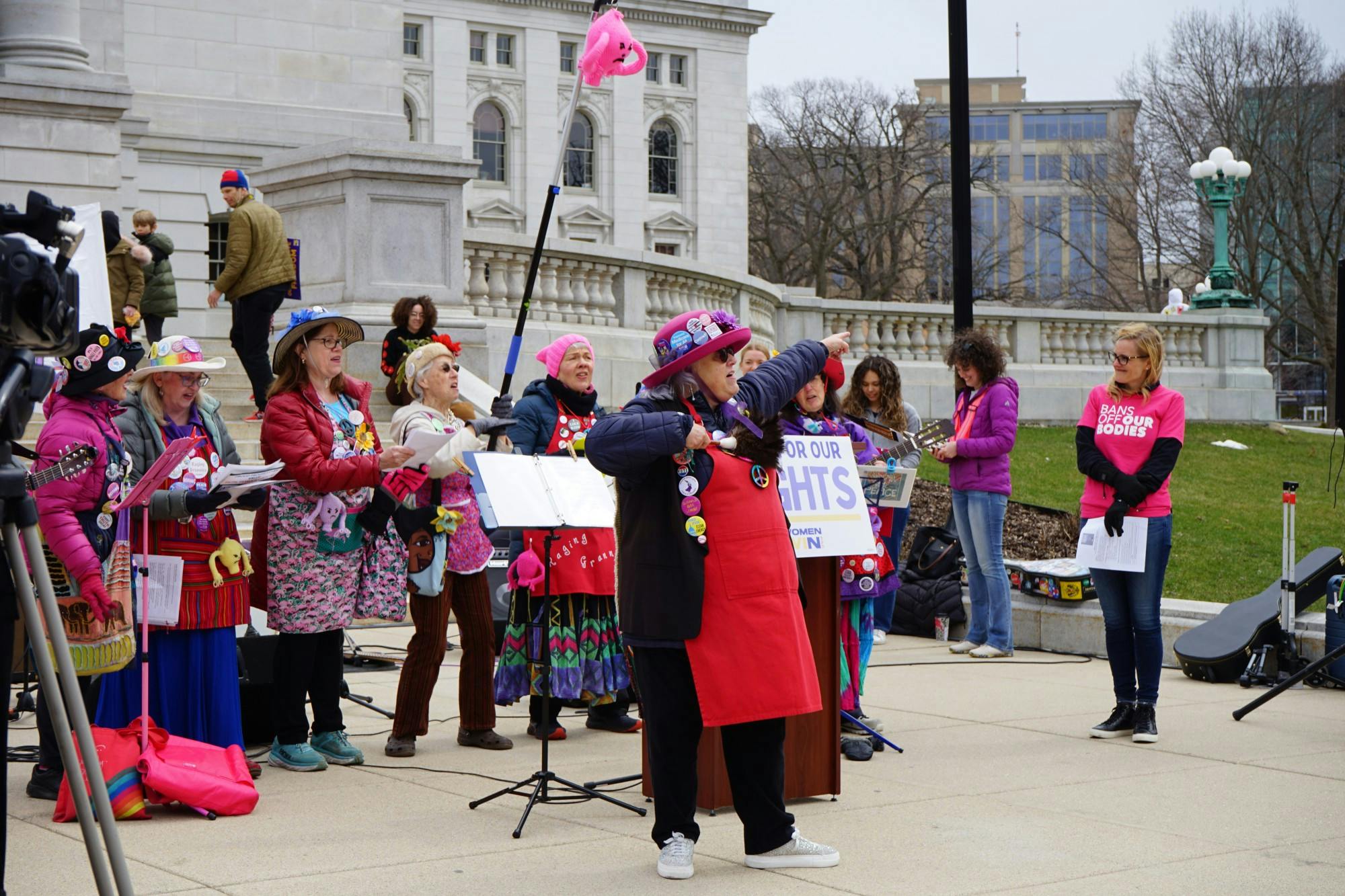
Raging Granny member Jade Dell distinctly remembers the day she and the Raging Grannies of Raleigh, North Carolina were arrested.
“They [police officers] ordered us out because we were singing, and we wouldn’t stop singing,” Dell said. “A whole bunch of us got arrested. I think there were 21 that got arrested that day.”
Who are these strong-willed women not afraid of getting arrested at age 80? Meet the Raging Grannies.
The Raging Grannies are a “dis-organization” of older women who are best known for performing songs with original lyrics about social and political issues at civil protests and community events. Since leadership isn’t centralized, each community chapter calls themselves a ‘gaggle.’ While the original gaggle was founded in Canada, Raging Grannies can be found across the globe.
The Raging Grannies are known for political performance or guerilla theater, which is spontaneous performance art meant to bring attention to an issue. They perform cover songs with rewritten, socially-conscious lyrics and dress in extravagant outfits with slogans on buttons, shawls and aprons about causes — also forms of guerilla theater. The Madison Raging Grannies even created their own mascot: a uterus named Ursula in response to the overturning of Roe v. Wade.
While Raging Grannies participate in street protests, they’re best known for their singing performances, drawing national attention for bringing eccentricity, humor and music to activism.
Dell is no stranger to the consequences of protest, having been arrested with the Raging Grannies multiple times. She said a grandmotherly image doesn’t protect them from police intervention as much as people may think. “I’ve been arrested five different times in four different states,” Dell said. “I’ve been an activist for my entire life.”
About half of Madison’s Grannies have been activists their entire lives, while others only began public activism as a Granny.
Madison Raging Granny Jeanne Nye was a schoolteacher for 44 years, but it wasn’t until after she retired that she became involved with the Grannies because she said her job discouraged activism. Other members faced pressures like family disapproval or gender stereotypes that discouraged female activism. Involvement later in life gives many of these women an opportunity to do what they may have always wanted to do.
The Raging Grannies say they are politically conscious, not partisan. They focus on a range of issues, such as reproductive health, LGBTQ+ rights, voting access, climate change awareness, universal health care, Black Lives Matter movement and immigrant rights. They also attended No King’s Day protests all over the United States. Each gaggle also participates in community-specific issues, which differ based on the residents.
Nonviolence is an important pillar of the organization. “[The Raging Grannies] were never violent or abusive or said anything bad to people,” Dell said. “We just were firm in our beliefs that this was wrong.”
History of the Grannies
The original Raging Grannies began in 1987 in Victoria, Canada protesting U.S. military ships docked in the harbor. A group of women were upset with the boats in the harbor, so they took matters into their own hands. The women kayaked to the ships armed with a unique idea —dressing up like little old ladies and singing protest songs. Their performance caught media attention, and the women were so galvanized they decided to share the idea with others.
The Madison gaggle was founded in 2002 by the Women’s International League of Peace and Freedom. The women are a fixture at local protests, notably the Act 10 protests at the Wisconsin Capital in 2011. At the event, they sang five days a week for five months, and several members were arrested.
Is protest effective?
While the Raging Grannies’ guerilla theater performances have inspired many, some question whether their activism translates into policy change.
Dr. Sarah Frank, a gender and politics professor at the University of Wisconsin-Madison, said research has shown that street protest, part of what the Raging Grannies do, isn’t very effective.
“I don’t believe that they shape legislation because public opinion generally does not anymore,” Frank said. “And, anyone can make public opinion look like anything because of the age of mis- and dis- information.”
UW-Madison senior Michael Howe and founding member of the Student Nonviolent Action Coalition said groups like the Raging Grannies remind younger generations that pushing institutions to change is a long and ongoing struggle.
And for Dell, her advocacy has also been multigenerational, because it's motivated by leaving the world in a better place.
“The state of the world is really terrible, and we want to tell students that we are really embarrassed and sorry to leave the world in such a mess,” Dell said. “We would really like you to know how much we care about you, and how much we are trying every day to make the world a better place.”