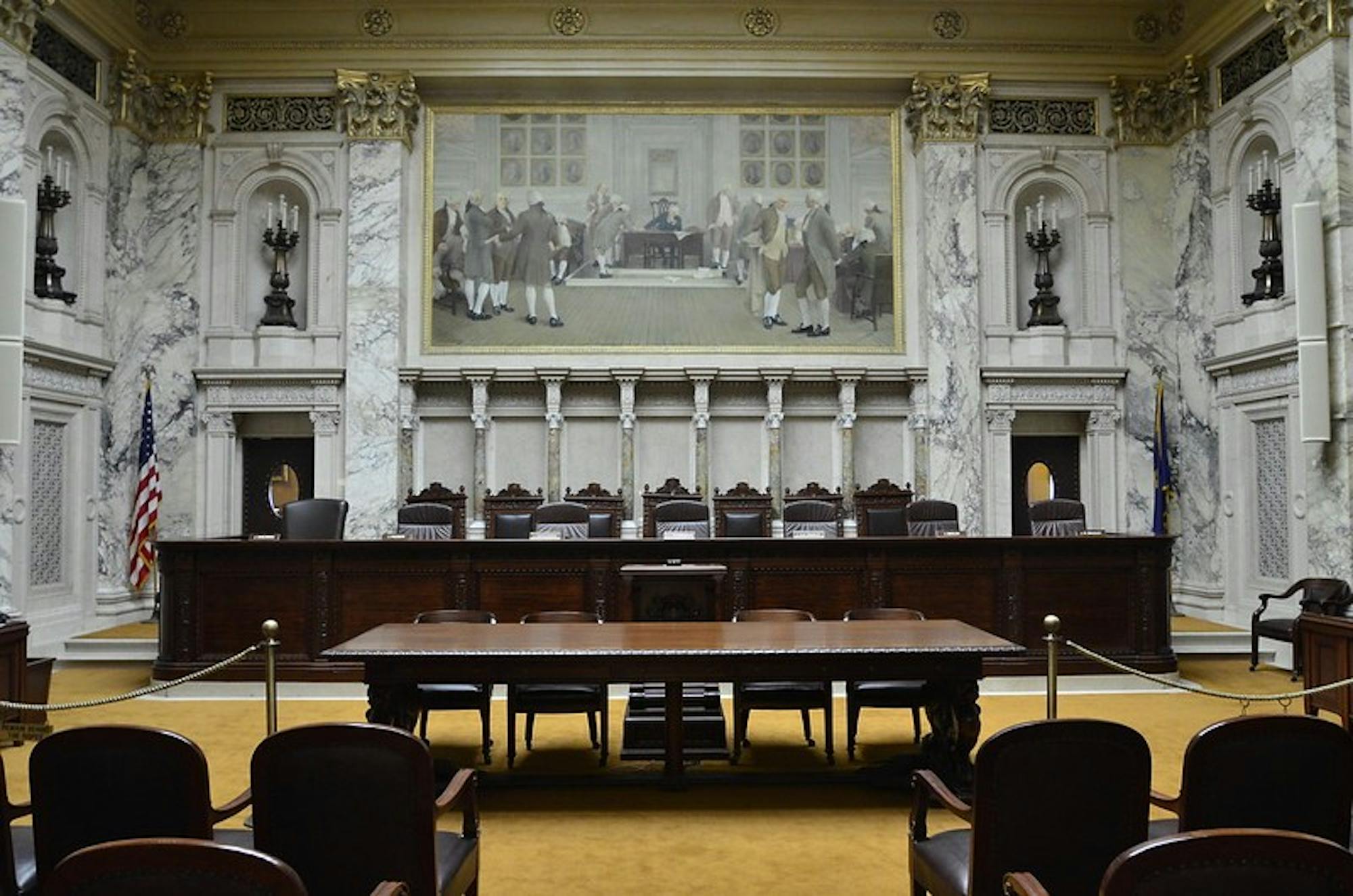
The Wisconsin Supreme Court assigned two three-judge panels on Nov. 25 to review two lawsuits against the state’s current congressional maps that could redistrict the state’s maps, although unlikely before the 2026 midterm elections.
One lawsuit centers on partisan gerrymandering, while the other argues Wisconsin’s current maps eliminate competition. The court assigned panels to each case because of a 2011 law passed by the Republican-controlled legislature which requires suits like this one to be heard by judges from different parts of the state, rather than a single judge in a district chosen by the plaintiffs. This marks the first time the court has deployed these panels.
Judges overseeing both lawsuits held hearings Friday, where both parties commented on the timelines of the two cases which will likely go to trial early 2027 after midterm elections, unless judges issue an expedited ruling.
Currently, Wisconsin is represented in Congress by six Republicans and two Democrats, despite a recent history of close state-wide elections.
The formation of these panels sparked debate among justices regarding the court's integrity and the potential for perceived bias.
What are the arguments?
The first lawsuit, filed by liberal firm Elias Law Group, centers on a traditional partisan gerrymandering argument. Plaintiffs argue the current congressional map unfairly penalizes Democrats by concentrating them into a few urban strongholds and scattering the rest across rural areas, effectively diluting their voting power, violating the state constitution's equal protection clause.
The second case, led by Law Forward, takes a more novel approach, arguing the map is illegal because it eliminates competition. Instead of focusing solely on partisan bias, this suit claims the map protects current politicians from both sides by creating "safe" districts where they can't lose. The six districts with Republican representatives and the two districts with Democratic representatives have elected representatives that way since the congressional map was drafted in 2011.
In an interview with The Daily Cardinal, University of Wisconsin-Madison professor and director of the Elections Research Center Barry Burden said both arguments are based on the state’s constitution instead of the federal Voting Rights Act, which has been used in other states like Texas undergoing redistricting lawsuits.
“[In Wisconsin] it's about some unique provisions of the Wisconsin Constitution, and trying to get judges to believe the arguments that lack of competition or discrimination against Democratic voters is inconsistent with the free speech provision of the state Constitution or good governance,” Burden said. “I think these judges have their work cut out for them to really think about some new arguments that haven't been seen in court much before.”
According to Burden, Wisconsin state law requires districts to be compact and practical. Wards, counties and other units and jurisdictions cannot be split. Federal court decisions require districts to be close in population, and the federal Voting Rights Act outlaws districts drawn with the intention to discriminate against racial or language minorities.
The court’s involvement comes at a critical moment, as both parties prepare for a struggle over control of the House in 2026. With Republicans only having a six seat majority, Wisconsin is a decisive battleground state that could determine the outcome of the election. With the Trump administration's urging, multiple states have started redistricting efforts including Texas and Indiana and in response, California voters also approved congressional redistricting efforts.
"We look forward to continuing the fight for fair maps in Wisconsin before the 2026 midterm elections," Abha Khanna, a partner at Elias Law Group, said to WisPolitics.
The three-judge panel
The formation of these two three-judge panels originates from a law passed by former Gov. Scott Walker and the Republican-led legislature in 2011, stating that no more than one of those judges can come from Dane County and the other two appointed judges must come from other circuits around the state, but it does not state how the judges must be selected.
“[2011 Wisconsin Act] scattered the judges, but that's all it said. It didn't say how the judges should be picked,” Burden said. “It appears that selections complied with the law, the justices made the picks.”
Justices disagree over how judges were picked
Conservative Justice Annette Ziegler responded, accusing the court’s liberal majority of giving “political advantage” to Democrats, pointing out that five of the six lower-court judges chosen for these panels publicly endorsed liberal Justice Susan Crawford during her campaign for the 2025 Wisconsin Supreme Court election.
“Hand-picking circuit court judges to perform political maneuvering is unimaginable,” she wrote in her dissent.
While conservative Justice Brian Hagedorn agreed that the 2011 law required panels to be formed, he disagreed with how the judges were selected. He argued that to protect the court’s reputation and ensure fairness, the judges should have been drawn by a random lottery rather than chosen by name.
“This approach is an odd choice in the face of a statute so clearly designed to deter litigants from selecting their preferred venue and judge,” Hagedorn wrote.
The court appointed Dane County Judge Julie Genovese, Milwaukee County Judge Mark Sanders and Outagamie County Judge Emily Lonergan to preside over the Elias lawsuit. Lonergan, who was appointed to the bench by Gov. Tony Evers, is the only appointee not to endorse Crawford.
For the Law Forward lawsuit, the court selected Dane County Judge David Conway, Portage County Judge Patricia Baker and Marathon County Judge Michael Moran.
The timing and possibilities
The legal battle has now moved to the circuit court level, but time is running short. The Wisconsin Elections Commission warned that any new district lines must be finalized by March 2026 to ensure candidates know which district they live in before the start date for circulating nomination papers.
“I think it's going to be difficult for the courts to move fast enough for this to be settled by the end of March,” Burden said.
The redistricting legal battle began when Texas Republicans redrew congressional lines mid-decade to secure five additional seats before the 2026 elections. In response, California redrew its own lines to favor Democrats, essentially offsetting Texas. Burden said the lawsuits in Wisconsin are different.
“In Texas and California, you have one party in control of the governorship and the state legislature. But Wisconsin has [a] divided government, so neither party can do this on their own, and there is no action coming out of the state legislature or the governor's office. All of this is in the courts,” Burden said.
In the event the three-judge panels decide the congressional maps to be unconstitutional, it would require the state legislature to draw new districts, which Burden said could take weeks or even months.
“The only kind of wild card is potentially the courts could change the date of the filing for candidates, or even of the primary… This happened in Texas before in a previous cycle, redistricting was held up in the courts, and the judges actually changed the date of the Texas primary to allow the litigation to play out…that's an outside possibility,” Burden said.
While Democrats are trying to quickly drive these cases forward to get new maps finalized before the 2026 elections, Burden said Republicans are expected to try to delay the process until after the midterms.
“The Democrats and the plaintiffs in these cases are gonna be pushing at every step to try to hurry things along. They would really like these to get resolved in time, to maybe put new maps in place for 2026,” Burden said. “Republicans are going to try to slow down that process and create as many roadblocks as possible, so they can delay until after 2026, so it might not be until 2028 that the new maps would come into place.”
New maps could produce a 5-3 or 4-4 split as opposed to the current 6-2 split, but Burden said a Democratic majority would be unlikely given Wisconsin’s recent outcomes.
“There are two districts now that are held by Republicans… but it wouldn't take very much changing of the maps to push the third district, and the first district into competitive territory. I think there's an outcome where Democrats could imagine winning half of the seats, but there's no kind of map where they could win a majority,” Burden said. “A 50-50 split is about the best Democrats could hope for.”