A series of federal and campus funding cuts have plunged the University of Wisconsin-Madison’s foreign language programs into financial uncertainty.
Last spring, UW-Madison regularly offered 31 different foreign languages through the fourth semester level, but now, the future of many lesser-taught languages are in limbo after the Trump administration withheld federal funding and university-ordered campus-wide budget cuts.
Indonesian and Vietnamese have struggled to regain their lost funding, the university combined Hindi with Urdu, and Filipino is expected to be cut entirely as a language offering starting next fall, according to Department of Asian Languages and Cultures (ALC) Administrator Jennifer Hekman.
The Trump administration dismantled the Department of Education’s office of International and Foreign Language Education in March which administered funding for these language programs.
UW-Madison is home to eight previously federally funded National Resource Centers (NRCs), which contain academic programs on world regions of interest to national security like Latin American, Caribbean and Iberian Studies and The Center for Southeast Asian Studies (CSEAS).
These centers, originally administered through the Department of Defense during the Cold War, aimed to build foreign language and area studies programs at universities like UW-Madison through Title VI of the 1958 National Defense Education Act.
CSEAS previously received Title VI funding for the first four semesters of Indonesian, Vietnamese and Filipino language instruction, the center’s Associate Director Michael Cullinane told The Daily Cardinal.
ALC provided one-time funds to bridge what Title VI would typically cover to keep the language programs funded for the 2025-2026 school year, Hekman told the Cardinal. The funds fully support the Filipino program this year and share costs for Vietnamese with CSEAS.
Not including fringe benefits, Filipino language instruction lost $32,074 in federal funding, according to documents obtained by the Cardinal. Vietnamese and Indonesian instruction lost $42,997 and $35,721, respectively.
Fall 2026 course offerings and cuts
As the university also faces campus-wide budget cuts, ALC reduced overall spending on the 13 languages the department administers while attempting to preserve foreign languages for next fall that previously relied on federal funding.
Hekman said ALC and private grants from CSEAS will support Vietnamese and Indonesian for next school year, but this funding is not guaranteed in future years and will need to be annually evaluated by the department.
ALC will not renew the contract of one of two Indonesian instructors at the end of spring 2026 and will increase the load of the remaining instructor to continue teaching all levels currently offered.
Hekman said a committee of university faculty, staff and graduate students made the decision to stop supporting Filipino after weighing undergraduate enrollments, ALC programs and faculty research.
Cullinane said he finds the loss of Filipino language instruction devastating, both professionally as someone who runs the Southeast Asia program and personally because he studies the Philippines.
“We're losing the opportunity to [teach] Filipino, which is the largest enrollment in the Southeast Asia language program,” he said. “So it's a big loss, both for the Center, for ALC, as well as for the community of people who are interested in studying the Philippines.”
The Filipino program currently enrolls 31 students, not including those from other Big Ten schools like Minnesota, Iowa and Rutgers. Multiple Big Ten schools that formerly taught Filipino stopped instruction for this current school year after losing Title VI funding and have instead enrolled their students virtually in UW-Madison’s Filipino program through the Big Ten Academic Alliance ‘CourseShare’ program.
Hekman and Cullinane said they hope UW-Madison and other Big Ten students enrolled in the program can continue learning Filipino through the CourseShare program at another university.
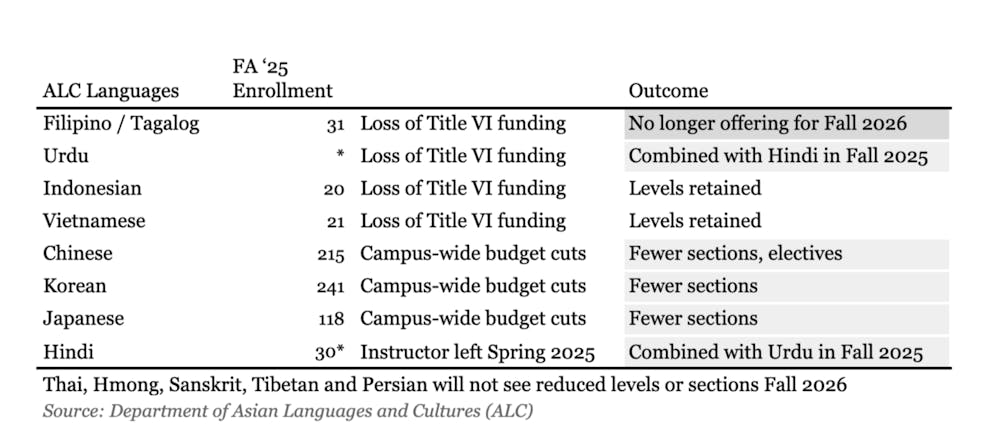
Due to campus-wide cuts, Chinese, Korean and Japanese reduced section offerings this fall while retaining all levels of instruction. ALC expects to keep those reductions in place next fall.
Hekman acknowledged the impact fewer sections and larger class sizes can have on learning outcomes.
“The larger [the class] is, the harder it is to provide the attention that each student needs and to individualize work,” Hekman told the Cardinal. “We are doing everything we can to minimize the impact on student learning, but I don't see how it can't eventually hurt students or negatively affect student learning.”
In Spring 2025, UW’s Hindi instructor left and Urdu lost its Title VI funding. While Hindi, an official language of India, and Urdu, the national language of Pakistan, are separate languages with different writing systems, they are ‘mutually intelligible.’
To preserve both, ALC created a combined Hindi-Urdu program taught by the former Urdu instructor and supported by nonfederal Hindi funding in fall 2025. This arrangement is expected to continue through fall 2026.
When the programs were separate in 2024, Hindi and Urdu had an enrollment of 23 and 21, respectively. Now, the enrollment has fallen to a combined 30 students this fall.
Other language offerings remain uncertain
Instruction in Yoruba, an official language of Nigeria and widely spoken in Togo, Benin and Sierra Leone, also lost Title VI funding at UW-Madison. The Department of African Cultural Studies is discussing restructuring its annual courses and offerings, but sources close to the situation say no determinations have been made on whether Yoruba instruction will continue in fall 2026.
The Department of German, Nordic, and Slavic+ is home to 14 foreign languages from Danish to Turkish to Kazakh. Some of these languages lost Title VI funding, according to a staff member in the department who did not specify which languages lost funding. No determinations on whether these languages will continue in fall 2026 have been made.
The future of foreign languages at UW-Madison
According to sources familiar with foreign language funding, some within these departments remain hopeful that Title VI funding may return in a few years, while others fear federal funding for these programs, and NRCs more broadly, are permanently gone.
“It's my job to plan on the worst case scenario,” Hekman told the Cardinal. “We've been able to navigate the federal cuts and the campus cuts. When I do budget projections, I am not seeing a need to make any changes to our programming, but at the same time, [we] don't know what's coming.”
What remains unknown is how UW-Madison’s new budget model, set to roll out in fiscal year 2027, will affect foreign language offerings. The UW Office of Finance and Administration plans to allocate undergraduate tuition revenue to schools based on credit hours and student headcount, or how many students call that school home.
With many students taking foreign languages as a second major or not seeking a language degree at all, changes in base budget and tuition revenue allocations under a new model could impact offerings for lesser-taught languages and foreign language instruction.
"UW-Madison believes Title VI programs are critical to U.S. security, diplomacy, economic competitiveness and the language and cultural expertise that is needed across all sectors,” university spokesperson John Lucas told the Cardinal. “Both the department and the administration are continuing to explore other funding sources, including foundations and private philanthropy, to support this critical department."
Cullinane told the Cardinal that he and other advocates for Filipino language instruction, like members of the Filipinx American Student Organization (FASO) at UW, are exploring non-traditional funding options in hopes of preserving the language at Madison.
The loss of federal support for these languages and NRCs has made the future of foreign language and area studies — once considered essential to national defense — uncertain at UW-Madison and universities across the country.
Editor's Note: This story was updated at 4:16 p.m. Dec. 5 to reflect that CSEAS is sharing costs with ALC only on the Vietnamese program, not the Indonesian program as well.
Ty Javier is a senior staff writer and photographer at The Daily Cardinal. He specializes in data analysis and written in-depth on PACs, university and campaign finances, economics and transit. He is an Economics major. Follow him on X @TyRJavier.