

SCIENCE
Ask Mr. Scientist: Silly string and trick candles
By Michael Leitch | Apr. 9, 2013Dear Mr. Scientist,
Dear Mr. Scientist,

It was only several years ago the “sit-ski” technology developed by University of Wisconsin-Madison engineering professor Jay Martin and his assistive and rehabilitation technology design class was created, but the impact since the start of the project has been huge.

There is a room in the Biochemistry building overflowing with scientific gadgets and gizmos. The dull glint of old microscopes and beakers sitting on every available flat surface is conspicuous against the piles of papers and boxes. Hidden behind this hodgepodge sits the desk of Professor Emeritus of biochemistry David Nelson: His necessary “I’m back here” is a beacon of sound guiding me through his office.
In a class discussion a few weeks ago, the professor posed a question to those in attendance: How do you define science literacy? While this may seem to be a simple question to answer, that was not the case for the roughly 100 people there.
Researchers at the University of Wisconsin-Madison have developed a technique for measuring proteins that could expedite the research being done on diseases such as diabetes and cancer.
You want to be a doctor. This could be a completely new realization or a chronic one. The goal remains the same however. The first hurdle in becoming a doctor with a capital “D” is getting into medical school. You may have heard that medical school will make you crazy, and let me tell you personally, that it starts with the application. The process of applying is long, expensive, time-consuming and all sorts of hair-yanking and zit-inducing stressful. But we know its rewards, a career in medicine, and this can make the whole process worthwhile.
Dear Mr. Scientist,
One day, while at work, I made a joke referencing evolution. My coworker laughed at it, but then turned solemn and said, “But seriously, you don’t actually believe in evolution, right?” The question took me aback and sparked a half-hour-long discussion about science and its place, or lack thereof, in religion. The problem my coworker had was he belonged to a Christian denomination that practices biblical literalism. This is the idea that the Holy Bible used by Christians was word-for-word inspired by the Holy Spirit, and is therefore infallibly correct (note that there are other versions of this idea and not all Christians who consider themselves biblical literalists will agree with the definition my coworker was using). Because of this, he was obligated to believe Earth was indeed created in six days by God and on the seventh day God rested and all was as it ever would be. Genesis says so and Genesis is infallible. Many of us have probably had a similar discussion and I think it is important to take a moment to look at the issue. There isn’t sufficient space in one opinion column to cover every detail and aspect of this issue, so you can expect me to cover different parts of it in the coming weeks. Today we will look at a basic overview of the problem.

Sitting in the waiting room of the Veterinary Medicine Teaching Hospital, it is easy to see the care and attention that is paid to the patients at this facility. Even with the excited barking of dogs, insistent shushing of the owners and general chaos of the clinic, all the employees seem genuinely happy to help owners as they come in to pick up medication or bring a pet in for an appointment. It is this love for animals and sense of value for a pet’s life that make veterinary clinics like this necessary, and animal blood banks all the more crucial.
In a moment of fear, the flight or fight response is instinctual. A small cluster of cells buried deep in the brain called the amygdala is known to be responsible for this basic response. Beyond this, the amygdala is involved more broadly in the processing of memory and emotional reactions.
Dear Mr. Scientist,

This in no way meant to be funny. Take my arguments how you will, but whatever you do, don’t chuckle whatsoever, or I’ll get violently angry. I think aliens are totally real. And by God (does it make sense to use Him/Her in this context?), you will not convince me otherwise.
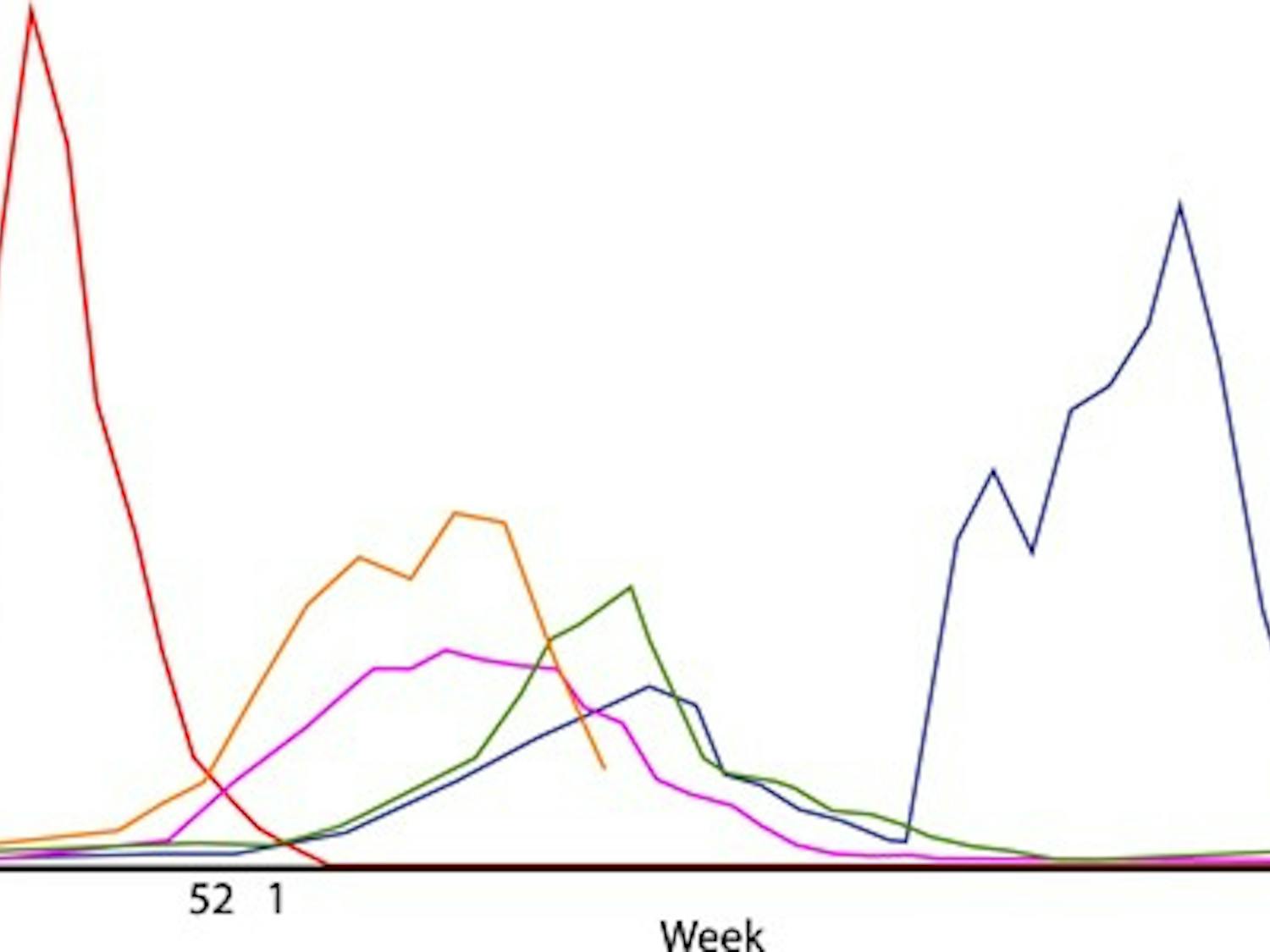
Those looking to know whether the worst of flu season has passed may be disappointed to find out that the most predictable thing about flu is that it’s unpredictable, according to Dr. Tom Frieden, director of the Centers for Disease Control and Prevention.
Many college students read science journal articles as a requisite for class and directed studies toward understanding experimental details. However, more often than not, most research endeavors involve a narrative about collaboration across several disciplines leading up to the discoveries published in journals.
Dear Mr. Scientist,
It is hard to picture starfish as the thugs of the marine world. But ravenous, thorny starfish have been terrorizing and destroying Australia’s Great Barrier Reef for almost three decades.
Dear Mr. Scientist,

Mediation could change how people experience pain, recent findings by researchers at University of Wisconsin-Madison reveal.
Imagine holding a state-of-the-art research laboratory in the palm of your hand. The device can go anywhere you go, and nearly anyone can operate it. What would you do with it?
Dear Mr. Scientist,
 Read on Issuu
 Solutions by The State News