If you took a college football fan from the turn of the millennium and dropped them inside Camp Randall on a Badger gameday, most things would probably be pretty familiar.
The sound of the Badger band playing, pads clashing and thousands of Badger fans cheering in on any given Saturday. But, if you were to tell this hypothetical fan Wisconsin spent around $30 million paying its players to assemble this year’s roster, they would probably look at you like you were living on another planet.
The advent of Name, Image and Likeness (NIL) has fundamentally altered the landscape of college sports, and nowhere is that evolution more apparent than in college football.
For instance, every single team that has appeared more than three times in the College Football Playoff (CFP) — a system implemented in the 2014 season — spent over 30 million dollars, with the lowest spender being the Clemson Tigers at around 30 million exactly.
Every team that has ever played in the CFP championship game since NIL’s implementation in July 2021 has spent over $20 million to build its roster this season.
The picture rapidly becomes clear: deep NIL funds are a central pillar of success in the modern age of college football.
The Wisconsin Badgers, however, land in a curious position in a study done by the Athletic. Despite the Athletic’s report of NIL spending for Badger football landing at around the $30 million range — where premier programs like Oklahoma, Penn State, Georgia and Clemson live — the Badgers have not been able to replicate the success of those programs.
While those four programs averaged nine wins last season, with Georgia and Oklahoma winning 12 and 10 games respectively, the Badgers posted a comparatively woeful 4-8 record, near the bottom of the Big 10.
The obvious conclusion is that Wisconsin football is spending like a premier program, yet the on-field program has been far from that.
To better understand how Wisconsin’s NIL spending translates to the team’s play on Saturdays, a breakdown of the roster is immensely helpful.
Though precise NIL numbers and exact payments to each player remain closely guarded information, estimates are available to give an idea of how the aforementioned $30 million is distributed.
It is useful to compare Wisconsin’s roster distribution to the most similar program of the Big Ten conference: the Maryland Terrapins.
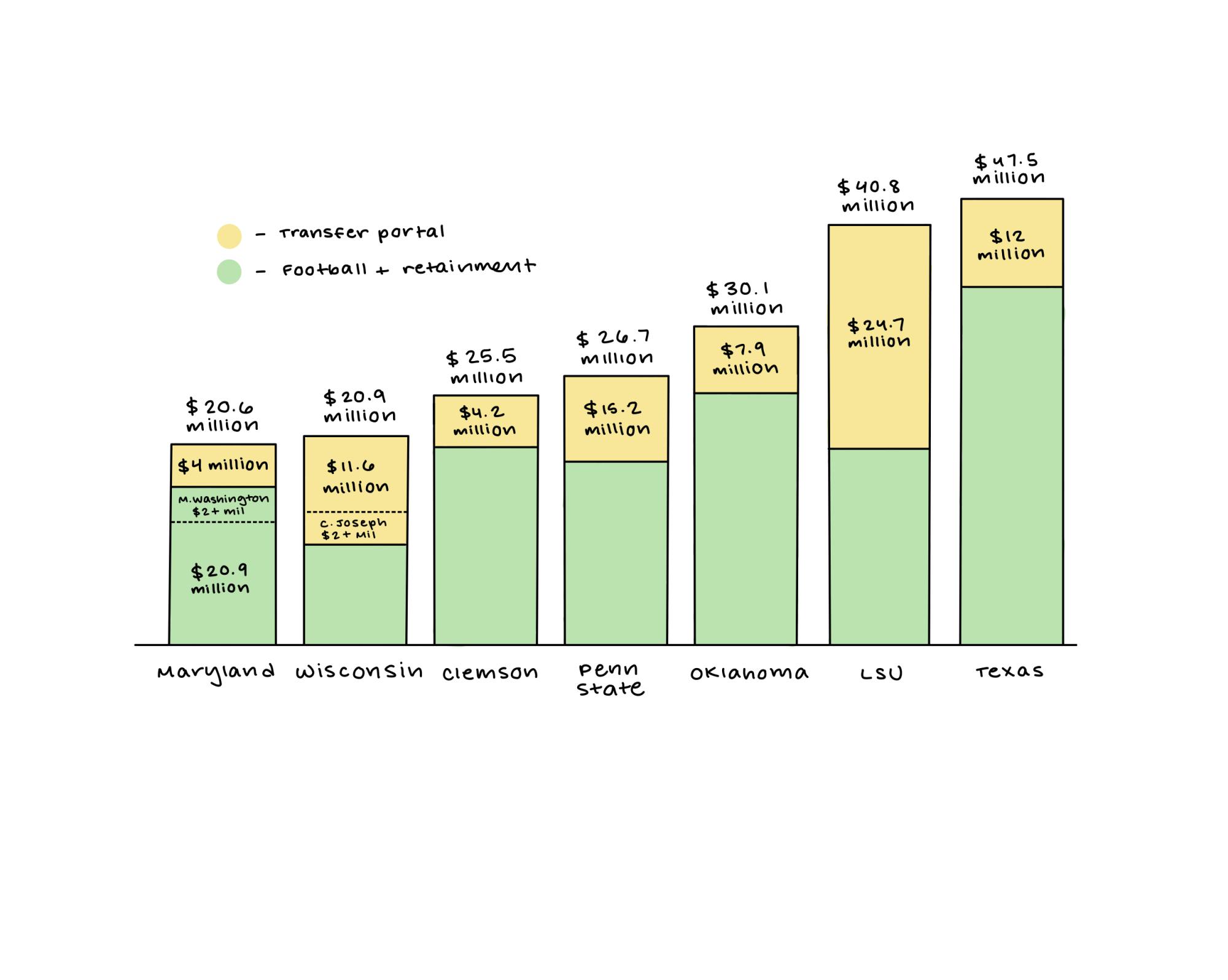
Like the Badgers, the Terps posted a four and eight record last season, and the most reliable broken-down estimate of NIL rosters by player places Wisconsin and Maryland only $300,000 apart, at $20.9 and $20.6 million respectively.
Both teams have a major NIL outlier; quarterbacks Colton Joseph of the Badgers and Malik Washington of the Terrapins both have estimated NIL values of two million dollars or more.
These figures, both far more than any other player on either team, compound the pressure on quarterbacks that has historically existed; offensive system and specific quirks of a team be damned, the man under center has by far the highest expectation to perform.
However, there’s also a major difference that emerges in the structure of these two currently middling Big Ten rosters, which might give Wisconsin fans reason to be excited for the seasons to come. 76% of the Terrapin’s total NIL spending, or $15.6 million, was spent on retaining players, with only $4 million spent on the transfer portal. This reflects a relatively low rate of acquiring players in the portal, meaning hardly any major new talents on the teams.
By contrast, the Badgers used over half of their NIL spending, or $11.6 million, on recruiting new players in the transfer portal.
Quarterback Joseph was the biggest splash, alongside starting running back Abu Sama III, who has averaged 6.8 yards per carry in the first three games of this season. The performances of Old Dominion transfer Joseph and Iowa State transfer Sama have been highlights for the Badgers offensively so far this season.
This type of heavy portal spending is likely key if the Badgers want to reinvigorate a once-great program, as we see it corroborated by the very best in the game, even down in the Southeastern Conference. The No. 1 Texas Longhorns spent $12 million in the portal to assemble this year's roster, picking up key offensive weapons like wide receiver Cam Coleman and running back Hollywood Smothers.
The LSU Tigers, spurred by the hiring of Lane Kiffin, dropped a whopping $24.7 million on transfer players — 60% of their total NIL spending — on stars like quarterback Sam Leavitt and defensive end Princewill Umanmielen.
This litany of statistics presents a nuance of the NIL era of college football. At least for the moment, developing homegrown talents has taken a backseat to plugging and playing proven performers like Leavitt, a transfer from ASU, or Coleman at Texas, a former Auburn Tiger.
The Badger’s on-field performances since the advent of NIL have left a lot to be desired, and results can never be promised for certain. However, all signs point to continued spending in the transfer portal, following the trend set by top programs, will massively aid Badger football in returning to the national prominence of the Alvarez years.
While this high spending and aggressive portal tactics certainly inspires hope among Badger fans, it also increases the demand for results, and fast. Deservedly or undeservedly, the ire of Badger fans has been directed onto head coach Luke Fickell. Fickell’s teams have been wrought with injuries — last season saw four different starting quarterbacks — but the expectation, at least for this season, is undoubtedly a marked improvement over last year’s directionless performances.
To put it simply, now that the Badgers are spending like a high-calibre program, they are being expected to win like one. Couple that with this year’s schedule being regarded as one of the weakest in the Big Ten, where only three of Wisconsin’s remaining opponents are ranked in the top 25.
If we look back at the Athletic's article, out of Wisconsin’s upcoming nine opponents, only two of them have a higher budget — University of Southern Carolina and Penn State. As for the other seven, Wisconsin spent handily more than them this offseason. The 2026 season is likely a make or break campaign for Luke Fickell himself, but also an indicator of the direction of Badger football for the foreseeable future.