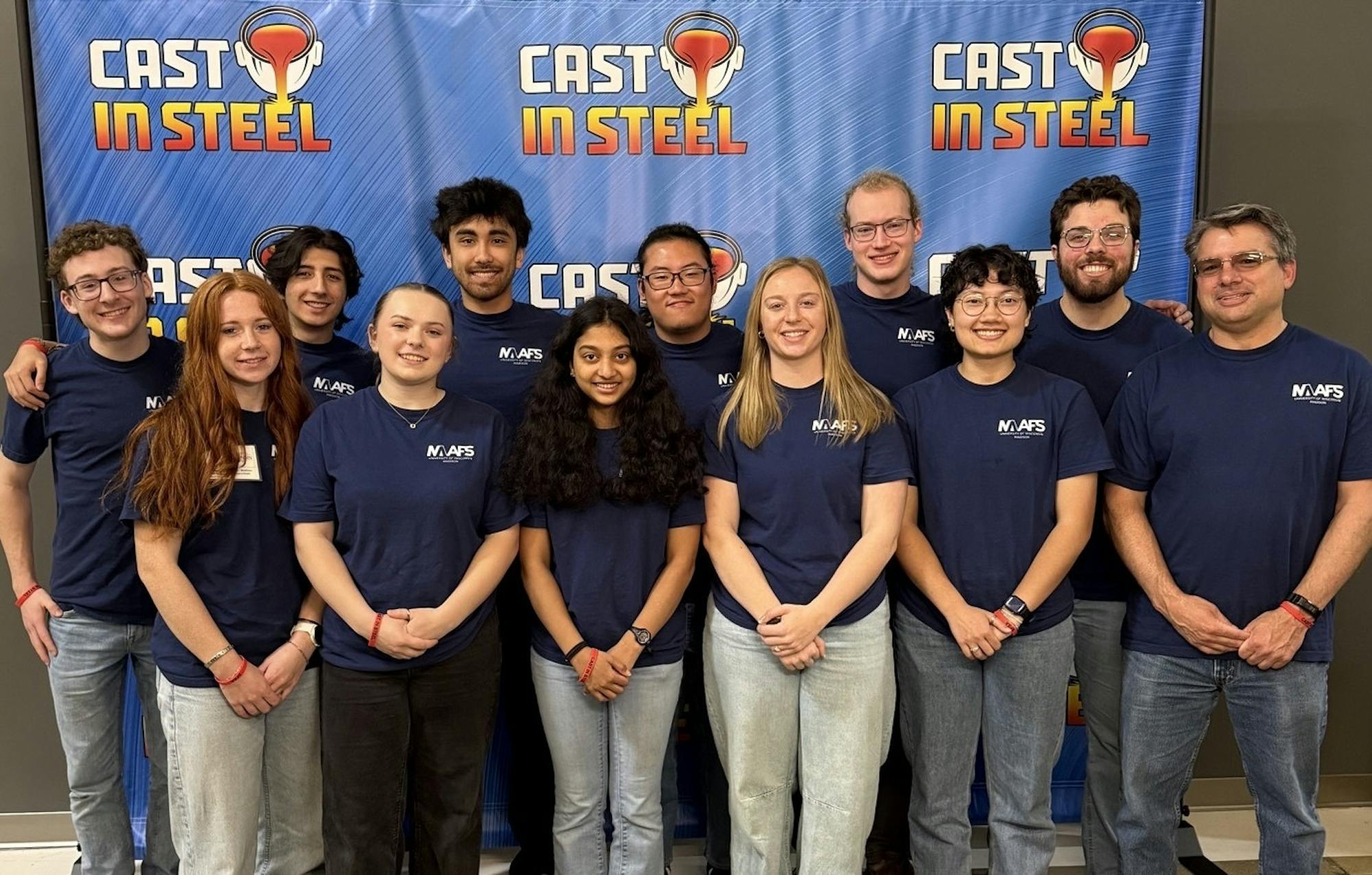
Two University of Wisconsin-Madison engineering teams swept the top two spots at a national collegiate metal casting competition in May. The competition premiered as a series on Youtube on July 9. Season one of the series focuses on the 2025 competition.
The Mad Badger Metalcasters and Mad-Town Axemen, who took first and second place respectively, spent nearly a year creating a horseman’s axe for the 2026 Cast in Steel competition. They bring the 25,000 grand prize award home to one of the highest-density manufacturing states in the nation.
Metal casting is the process of creating an object by pouring hot liquid metal into a mold, a manufacturing technique used across industries including agriculture, energy and construction, according to the American Foundry Society.
The Steel Founders’ Society of America (SFSA) has hosted Cast In Steel competitions since 2019, tasking university teams with designing, casting and testing a specific fully functional metal tool or weapon. This year is the first time the competition will be streaming as a show, premiering on Youtube.
For many materials science and engineering and mechanical engineering students, the Cast In Steel competition provides hands-on experience with metal casting and valuable industry connections in Wisconsin’s largest industry — manufacturing.
“Wisconsin has more foundries per capita than any other state,” Frank Pfefferkorn, a mechanical engineering professor and the teams’ advisor, told The Daily Cardinal.
Students at UW-Madison often find their way to the Cast in Steel competition through the university’s Material Advantage/American Foundry Society (MAAFS) student chapter, said Marisa Holding, a recent materials science and engineering graduate and Mad-Town Axemen team leader.
The Blazing Badger Bladesmiths, advised by University of Wisconsin-Platteville professor Kyle Metzloff, represented UW-Madison in the 2025 competition, where the teams had to create a replica of George Washington’s sword. Despite not taking home the grand prize that year, the team learned lessons that helped them win the 2026 competition, Holding said.
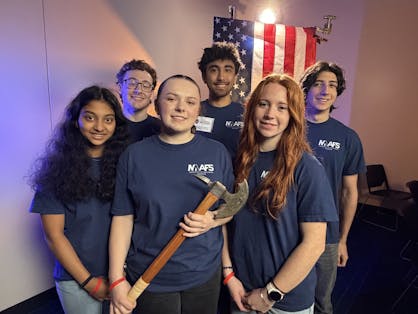
In 2026, SFSA challenged the competitors with creating a horseman’s axe, and UW-Madison was represented by The Mad Badger Metalcasters and Mad-Town Axemen. Many students who had competed the previous year joined the Mad-Town Axemen and the newer competitors formed the Mad Badger Metalcasters, who won first place.
After submitting their pieces, the two teams drove to Grand Valley State University in Grand Rapids, Michigan to test their pieces on chain mail in front of a live audience made up of a panel of industry experts.
‘It’s nerve-racking because you only get two swings,” Holding told the Cardinal. “What if you miss? What if you hit yourself? What if you break something? What if your axe breaks?… In the first round, there were two axes that snapped in half.”
Though the teams competed separately, more experienced team members collaborated with the new members across teams.
“[They] really mentored them along and applied all the skills and knowledge they’d gained,” Pfefferkorn said.
Holding said coordinating with foundry and heat treatment partners led to “having to be creative whenever there were limited resources”: for example, conducting a heat treatment for their axe in a small box furnace on campus after a company’s key furnace was down for maintenance.
Scheduling was one of the most difficult parts of the competition, according to Holding. Since the engineering foundry on campus permanently closed in 2024, students had no choice but to contact companies to pour for them.
“Being at the mercy of a different company’s schedule is so hard to work around,” Holding said. “It takes however long it takes because it’s just whatever fits into their schedule.”
Pfefferkorn told the Cardinal that based on the increase in interest and more young students coming in, MAAFS will probably have two teams compete again next year.
Holding, who starts at nuclear fusion startup Helion later this summer, said several team members received job offers from companies they connected with during the Cast in Steel competition.
“I am not one of the people that ended up going into the metal casting industry, but I think that if anyone is at all interested or curious, It's a great way to open up doors,” Holding said. “You’re getting to meet people who are in industry and then also getting hands-on experience that you wouldn't get otherwise.”