The Madison Museum of Contemporary Art (MMoCA) celebrated its 125th anniversary of free access to public art on June 4 by unveiling its new summer exhibits.
“Throughout [MMoCA’s] history, we’ve been free and open to the public as core to everything we do,” Andrew Rogers, Director of Communications at MMoCA, said. “In order to do that, it costs us about $50-$60 per person to actually have people come to the museum, so we absorb that cost.”
Private funding and events, such as Art Fair on the Square, help support the museum and the access it provides. Art Fair on the Square is one of MMoCA’s largest fundraising events of the year, and Rogers encourages those who are interested in art to attend or volunteer.
“I think everybody would benefit from spending more time with artwork,” Rogers said. “Being able to connect with each other, offline and in person, is a great way to have that social moment, to rethink a problem, approach it from a different angle, and [find] a more creative solution.”
Color, movement and lyrical abstraction
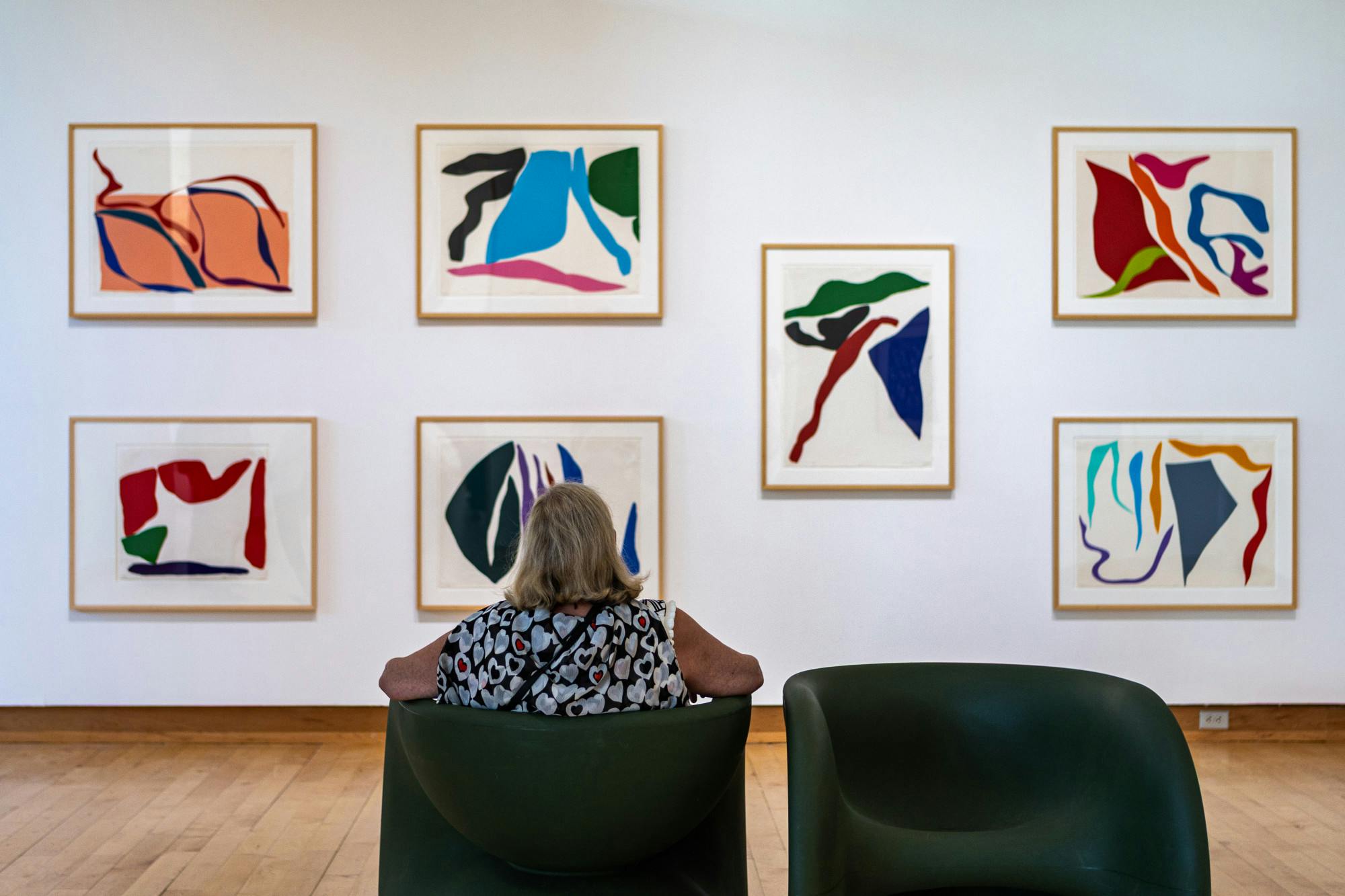
Extended Play: A-Side, a name inspired by vinyl records, is a collection of art that uses color to connect one piece to another, despite different artists, mediums, sizes and designs. The exhibit also examines artists’ use of movement to shape new techniques, especially through the language of music.
The exhibit houses works of Morris Louis, Kenneth Noland, Alma Thomas and other artists connected to the Washington Color School — a group of artists who collectively believed color drives meaning in paintings.
Sam Gilliam, another artist associated with the school, greatly inspired the Extended Play: A-Side exhibit.
The idea of lyrical abstraction, a style Gilliam followed, moves away from the strict geometry of hard-edge painting and minimalism into artworks with more fluid coloring, visible brushstrokes and layers.
Connecting the artworks to their lyrical roots, a few label headings read, “Swing and Synocaption,” “Complex Harmonies” and “The Head.”
MMoCA brought musical connection to viewers in more modern ways by providing a playlist with music that inspired the exhibition series.
A second installment, Extended Play: B-Side, will be displayed at a later time in the museum.
Many mediums
Other exhibitions on display include David R. Harper’s “Good Morning Sweetheart” and Gelsy Verna’s “Mother, Father, Please Help Me.”
Good Morning Sweetheart is a multi-media collection of three-dimensional artwork, including ceramics, sculptures, stained glass and textiles. Everyday household items are used throughout the exhibition to explore the memory of these objects. Artists purposefully altered these everyday items to prompt intentional viewing and discussion.
Mother, Father, Please Help Me honors Verna’s artwork and her time spent teaching at the University of Wisconsin-Madison as an associate professor before she passed away in 2008. Verna’s artistic style often prompts questions around identity, history and power.
David Dunlap, Verna's collaborator in creating the artwork on view, used layering techniques to combine many of Verna's works into a single large piece, following Verna’s belief that “images and symbols change over time, and that new meanings emerge through revision, proximity and combination,” according to MMoCA.