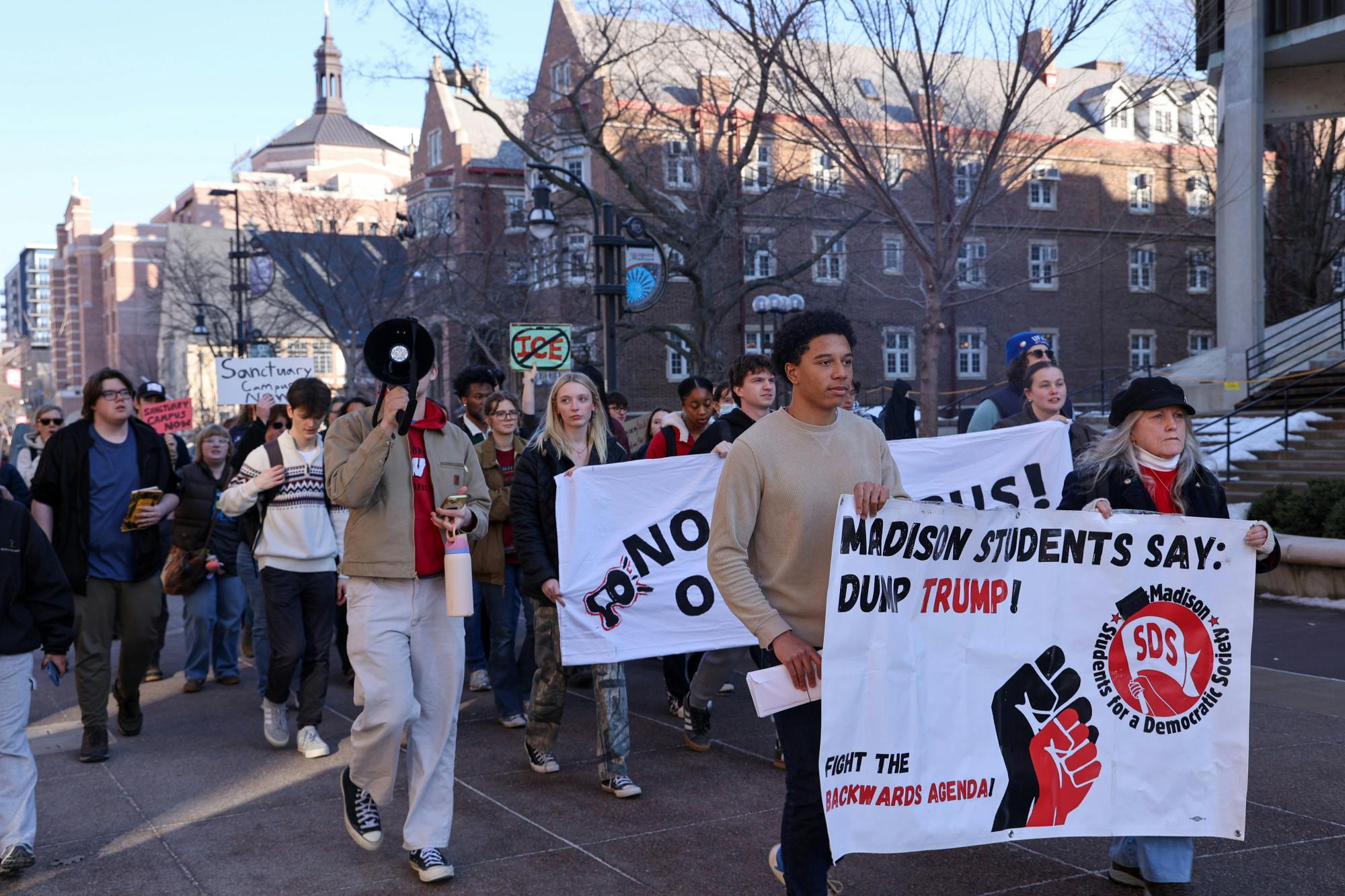
Dozens of University of Wisconsin-Madison students, faculty and alumni marched from Library Mall up Bascom Hill Friday to demand stronger protections for immigrants and international students on campus.
The rally was organized by the Madison chapter of Students for a Democratic Society with support from other student activist groups like UW’s Young Democratic Socialists of America chapter, Students for Justice in Palestine, Blk Pwr Coalition and Mecha de UW-Madison.
The protest was the latest move in student organizations' push to designate UW-Madison a sanctuary campus, which would keep university officials from cooperating with federal agents, in response to intensifying federal immigration agent presence in neighboring cities and states.
Speakers criticized Immigration and Customs Enforcement and emphasized the importance of protecting students, urging attendees to sign a petition created by YDSA to establish alert initiatives for potential ICE presence and provide resources to students.
The petition specifically calls for the university to implement a rapid response network notifying students of ICE presence on campus, set up a resource fund for vulnerable students using campus funds, implement procedures for remote work and paid leave if ICE is present on campus, remove all privately owned security cameras on campus and restore previous protest guidelines. More than 2,600 people have signed it so far.
UW-Madison’s current immigration policy states the university will not give out student information unless required by law, highlights that students have 24/7 access to the Office of Legal Affairs and suggests students do not try to intervene with ICE actions.
YDSA’s petition aims to take those guidelines a step further, outlining similar demands in addition to clear signage of public and private campus spaces, legal funds for students facing deportation, the withdrawal of Mnookin’s 2024 institutional neutrality policy and publicly reaffirming UW-Madison Police Department’s 2019 immigration enforcement policy.
For protest organizers, the issue runs deeper than documentation status.
United Faculty and Academic Staff Co-president Barret Elward stood atop Bascom Hill and called attention to the dramatic escalation in immigration enforcement worldwide. As ICE activity has increased throughout the Midwest, students and faculty alike voiced their concern that Madison’s “liberal reputation” may attract ICE next, urging the university to prioritize their students.
“UW admin has been focused solely on protecting the institution [and] brand of UW-Madison, not [their] students and workers,” Elward said. “What is the value [of this] institution without its [students, workers and teachers] that keeps this university ticking over?”
SJP member and speaker Mac Davido pointed to one key program outlined in the petition, the rapid-response network informing all students and faculty of ICE presence on campus. Currently, the local advocacy group Voces de la Frontera operates a 24/7 hotline offering advice, legal support and ICE verifiers in the event of a federal presence on campus.
Last week, YDSA shared the demands of their petition with UW-Madison Chancellor Jennifer Mnookin, YDSA Spokesperson Wesley Hoy told The Daily Cardinal.
“We’re now moving on to our second stage, which is organizing on campus, making those demands to the university and entering negotiations,” Hoy said.
Hoy said the biggest obstacle limiting the university’s designation as a sanctuary campus is Wisconsin’s Republican legislature.
Assembly Speaker Robin Vos, R-Rochester, introduced a bill in February 2025 that would require county sheriffs to cooperate with federal agents. Notably, 13 of Wisconsin's 72 sheriff's departments agreed to partner with ICE. The bill passed the Assembly along party lines, but was not voted on by the Senate. Gov. Tony Evers said he would veto the bill if it made it to his desk.
“A lot of the policies pushed through, especially under the Mnookin administration, have been pandering to conservatives in the Legislature,” Hoy said.
Students have framed recent university projects, such as the recent closure of the university’s diversity division and the formation of an initiative focused on open dialogue, as efforts to pander to the Republican Legislative.
Hoy also mentioned Mnookin’s responses to campus protests, including authorizing the police to raid the May 2024 pro-Palestine encampment and changing protest policy after the protests.
The new Expressive Activity Policy restricts students from protesting within 25 feet of campus building entrances, limits voice amplification and signage and protesting hours in heavily populated campus areas.
Hoy acknowledged, however, the university’s willingness to take immigration threats seriously.
“I’m not saying the university is subscribing to all our demands,” Hoy said. “But this is an issue that the university is taking seriously.”
Student activist Bradley Kenan told the Cardinal the next step is mobilizing student support and uniting people, especially those not directly affected by immigration enforcement.
In the meantime, YDSA is working on training student volunteers to verify ICE reports and connect detainees with legal support.
“We saw in Minneapolis that everybody’s related to ICE when ICE agents shot and killed Renee Good and Alex Pretti. At the end of the day, it’s about basic humanity,” Kenan said.
Editor’s note: Wesley Hoy was a staff writer for the Daily Cardinal.