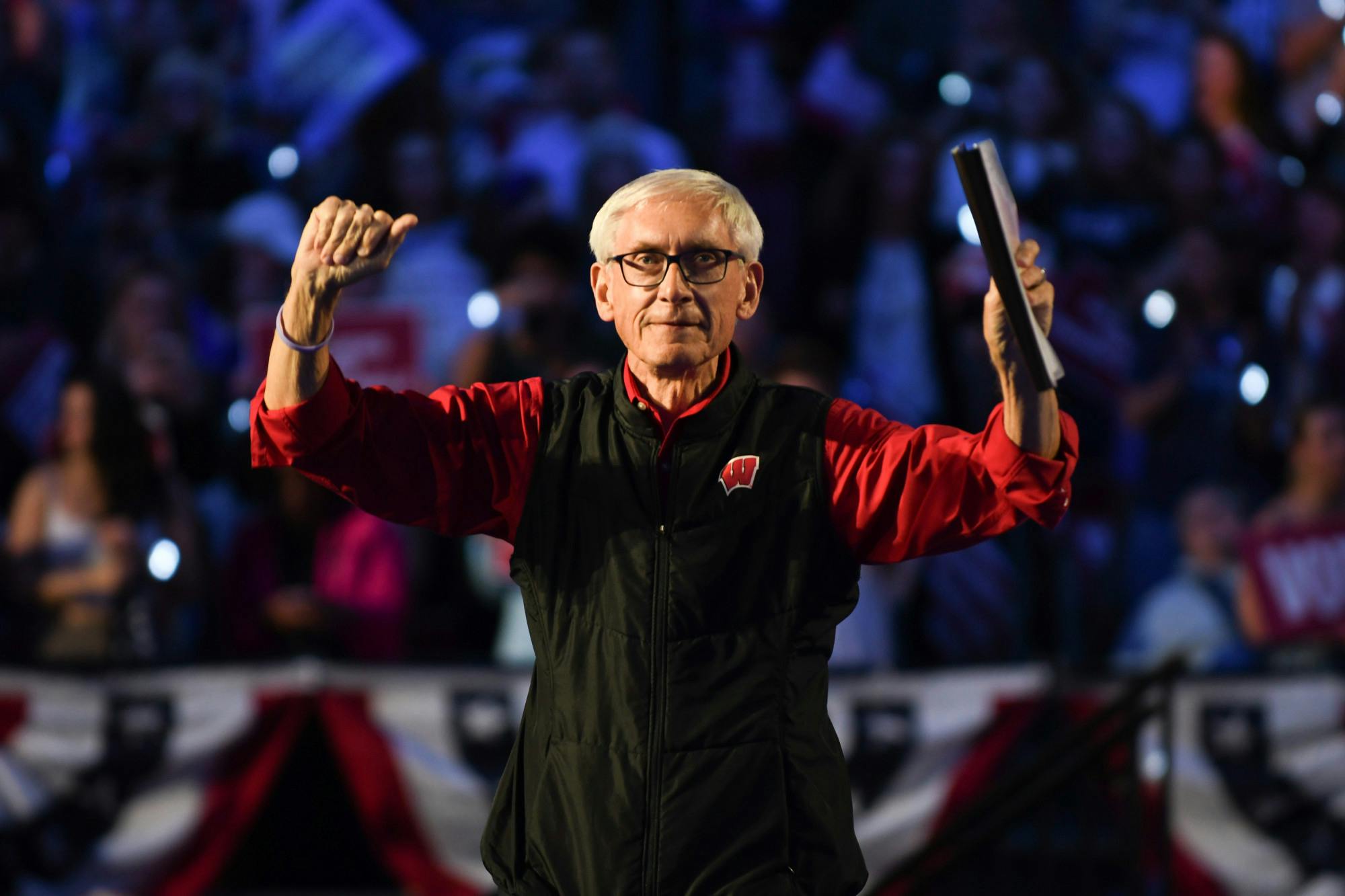
Gov. Tony Evers told The Daily Cardinal in an interview Wednesday he is in the process of negotiating with the Legislature what will be done with the state's budget surplus, but does not have a specific answer whether the University of Wisconsin System will receive any additional funding.
The Legislative Fiscal Bureau recently projected Wisconsin to end in a $2.5 billion surplus at the end of 2025-27 biennium, almost $1.5 billion more than expected when Evers signed the budget in July.
Evers said he is “possibly” interested in increasing funding and will “certainly” look into it, but said his top priority was relieving residents of property tax increases.
Evers said as he negotiates these next few months with the Legislature, they will “look at all options,” but he is “not in a position to guarantee anything right now” until he sees what the Legislature does.
With this surplus, Evers said he hopes lawmakers will approve property tax relief, which he originally proposed in the 2025-27 budget but was cut through negotiations with Republicans, who argue his 400-year veto from the last budget cycle raising per pupil spending by $325 per kid caused the surge. Property taxes saw the largest increase this year since 2018.
Evers stressed that although the UW System received less than the Board of Regents requested — and what he originally proposed — they obtained the largest funding increase in about two decades, even after some lawmakers proposed massive cuts.
The UW System received a $256 million increase in the 2025-27 budget, a major turnaround after Republican lawmakers threatened to cut funding by $87 million two weeks prior. However, the increase was significantly less than the Board of Regents and Evers’ original proposal of $856 million.
When requesting the $856 million, UW System President Jay Rothman said in a February interview with WisEye he would not recommend raising tuition or closing any additional branch campuses if the system received the full funding.
Soon after the UW System received about $600 million short of what they requested, tuition increased by 5% and the UW-Platteville Baraboo Sauk County branch campus closed in October.
As affordability remains a top issue, Republican lawmakers floated the idea of capping changes to in-state undergraduate tuition to the rate of inflation, introducing a bill that has yet to be passed by either chamber.
Evers, a former Board of Regents member, said he wants to ensure the board has a say in the idea and that he is “somewhat reluctant” to cap anything, but it still remains a “possibility.”
Evers emphasized his worries about capping tuition to the rate of inflation saying it makes things unsteady. He questioned if there ever was a sudden rapid increase in inflation due to the Trump Administration or tariffs, would the Legislature agree to a massive increase in tuition.
“It's not that I'm interested in having people going broke because they're sending their kids to college, nor am I thinking that capping is the answer,” Evers said, adding that the Board of Regents has the data needed to make a decision and that is where he thinks the starting point should be.
Also taken out of Evers’ original proposed budget was a $500 million response fund, meant to aid the state amid a possible loss of federal funding including if the Trump Administration implemented National Institutes of Health (NIH) cuts.
The Trump administration cut over $12 million in specific NIH research grants at UW-Madison in April, terminating federally-funded approved projects targeting research into coronavirus vaccine development and mental health disparities among transgender and nonbinary youth.
Without this response fund, Evers highlighted lawsuits Wisconsin joined challenging the Trump Administration’s attempt to cut funding, saying they have had some success in federal judges blocking the proposed cuts.
“Obviously, it's important to have research money, and it impacts the entire country, especially research that happens here at the University of Wisconsin,” Evers said. “We're on top of it. We're going to continue fighting for that. We've had some success, but we need more successes.”
Clara Strecker is the state news editor for The Daily Cardinal. She previously served as copy chief. Clara has written in-depth on the 2025 Wisconsin Supreme Court race, the 2024 presidential election and abortion rights. She will spend the summer interning with WisPolitics. Follow her on X at @clara_strecker.