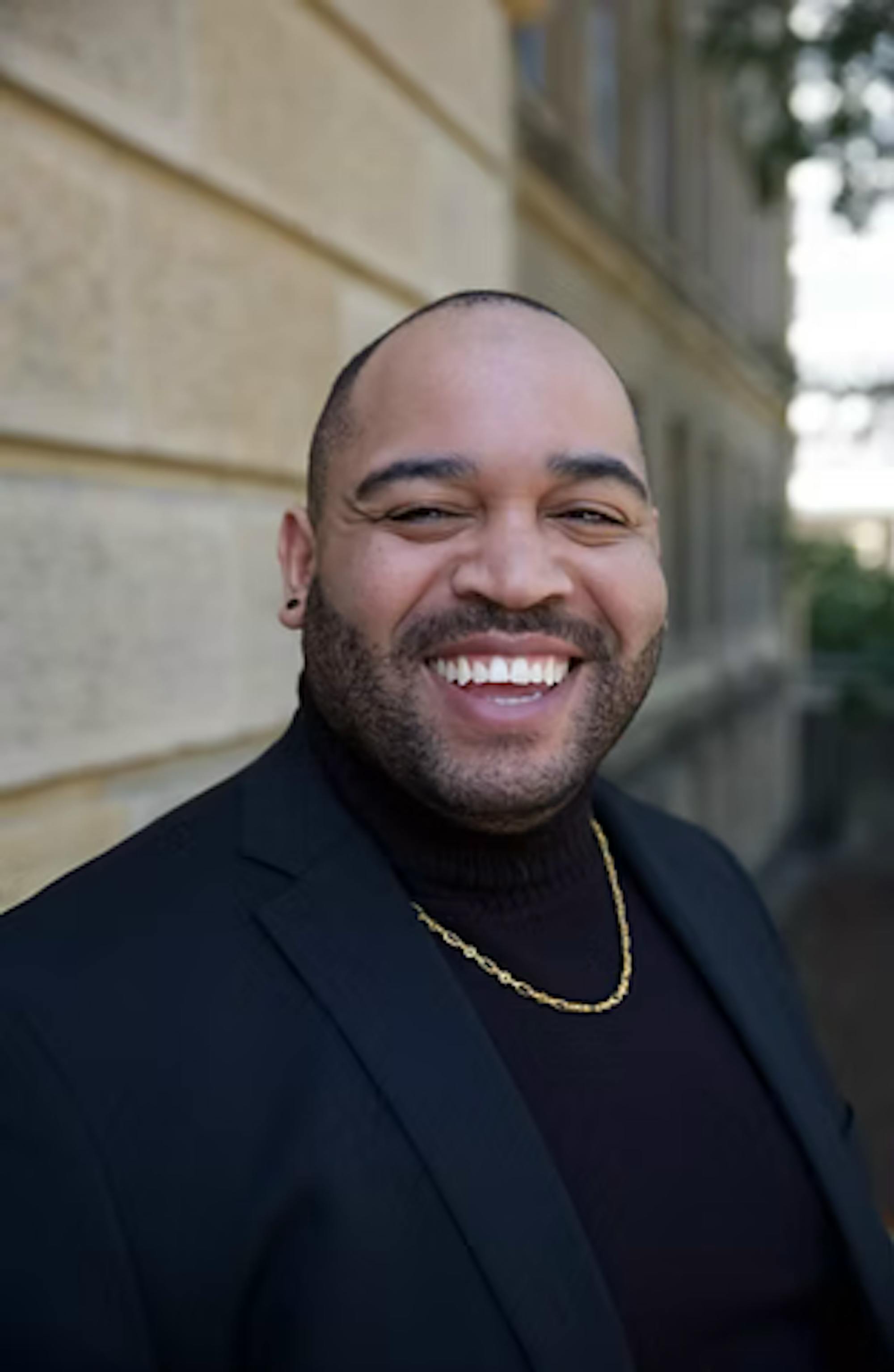
PhD candidate Morgan Henson received the Gulickson fellowship for the second year in a row, an award given to graduate students working to improve the teaching experience at the University of Wisconsin-Madison.
“I’ve always been interested in teaching,” Henson told The Daily Cardinal. “I think it’s my talent, my passion.”
His research focuses on how far-right political movements use digital platforms and media to gain political support. Outside the classroom, Henson is making a different kind of impact: helping his fellow teaching assistants.
Henson started TA Networks — groups of “intentional communities” for graduate student TAs navigating challenges often overlooked in TA training, such as microaggressions and topic-specific teaching dilemmas. He said TAs often struggle with feeling lonely in their work.
To help ease the stress, TA Networks hosts monthly Sanity Hours, evidence-based informal meetings dedicated to giving TAs time to socialize without the stress of teaching or research.
Henson said there’s been an overwhelmingly positive response to the meetings. Prior to his work in these councils, Henson noted TAs had unclear pathways for support.
“It kind of creates this apathy of ‘I can't really find it, so there's nothing really out there,’” Henson said.
Henson is now working with his boss Associate Dean Lynn Prost and campus partners to make these pathways clearer. For Henson, this work ties back to one of his core motivations: “letting people know that they are not alone.”
Henson is also an active member in UW-Madison’s Teaching and Learning Advisory Council and the TA Training and Support Team — organizations dedicated to easing the teaching and mentoring experience of instructors and TAs.
Drawing on his time with the councils, he said he’s learning better ways to streamline his research. His goal is to make it "understandable, presentable and actionable” to a general audience, and this commitment is reflected in his current research.
A look at his research
Henson’s current dissertation project focuses on how far-right groups use digital and social media platforms to normalize their beliefs. The preliminary findings of his research outline the ways extremist ideas are legitimized online in Germany and the United States.
In Germany, Henson found that far-right movements rely on non-German extremist groups to generate support for their beliefs. He said this reliance may stem from the country’s strict hate speech laws.
Because Germans cannot legally defend their hate speech, many seek the support of like-minded groups in other countries, such as Italy, France, Austria and the United Kingdom. Henson described this as a “back and forth” between nativism and internationalism.
“It's this very strange constant shifting between ‘Germany for Germans. Get these other non-Germans out’ but at the same time, ‘we need the Austrians and Italians and the French to let our people know that we have a right to kick everyone else out,’” he said.
In the United States, Henson finds far-right groups look inward, relying on political discourse for legitimacy. Henson said one example is how anti-establishment groups adopt MAGA rhetoric – groups that traditionally oppose both political parties now use the term “radical left,” language they hadn’t used previously.
By repeating familiar language, these groups work to mainstream their extremist beliefs. Henson worries this trend threatens the democratic norms of both countries.
The Boogeyman
When asked if German and American far-right groups are united by sharing a common enemy, Henson said the reality is more complex.
“For my research, it's less so one enemy, and more so one label that's assigned to multiple enemies,” he said.
He refers to these types of labels as the “quasi-Boogeyman.” He said groups assigned a label by the far-right are often seen as responsible for any problem that arises, even if they aren’t actually at fault.
The quasi-Boogeyman represents a catch-all scenario and provides a way for politicians and partisan groups to target people without providing evidence. Henson worries these far right groups may become a threat to democracy when they outcast those they perceive to be the boogeyman.
“Democracy only functions when everyone’s voice is equal… but not everyone’s voice is seen as equal,” he said.
He argues this labeling process can silence an entire group's voice, making it harder to have productive conversations about political and economic problems.
“When people aren't able to critically think through how exactly this group is at fault and all you can do is listen and allow people to guide you, then it's very hard to understand what the truth is,” he said.
While his findings are preliminary, his work speaks to a sense of division and polarization worldwide. Still, Henson’s work on the councils offers him what he sees as part of the solution to beating the boogeyman: critical thought and community.