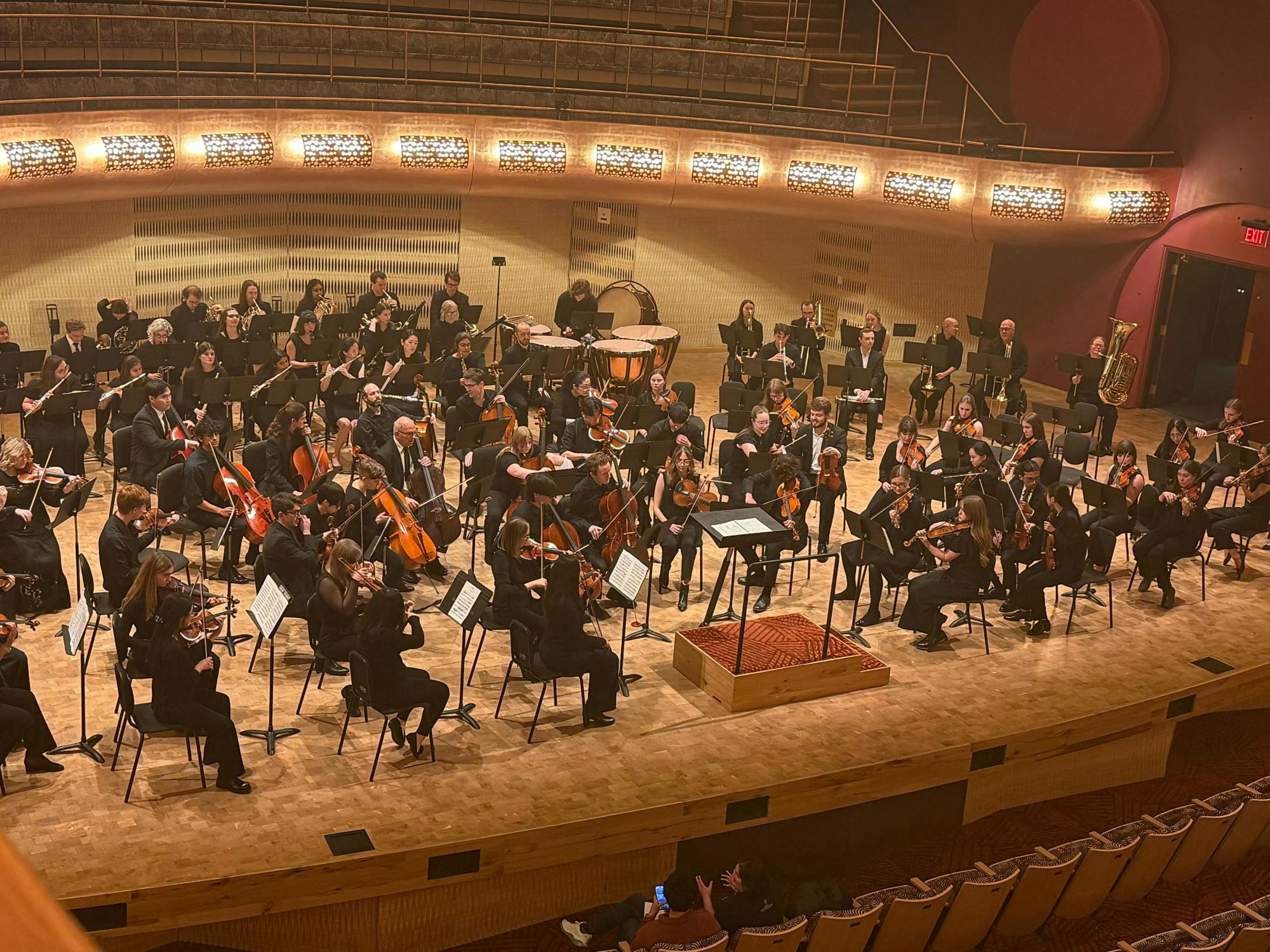
Musicians in the University of Wisconsin-Madison’s School of Medicine and Public Health perform classical music with surgical precision as part of the Medical Sciences Orchestra.
Founded in 2018 by fourth-year medical student Joohee Son, the orchestra provides a chance for new operations for students, faculty and alumni in the medical field.
Prior to each year, staff in the Orchestral Conducting program assign Master’s students to conduct each of the university’s four orchestras — the other three being the University Symphony Orchestra, the All-University String Orchestra and the All-University Philharmonia Orchestra.
Joe Mahin and Jared Sierra, second and first-year students in Orchestral Conducting, co-conducted the Medical Sciences Orchestra this fall semester. Once a semester the orchestra puts on a free performance in the Hamel Music Center, and just last week they hosted their fall concert.
Mahin has been one of the Orchestra’s co-conductors for the last three semesters and remains inspired by the dedication of each member.
“I’m really happy to be assigned to [this orchestra],” Mahin told The Daily Cardinal. “[The commitment is] very admirable for all of the doctors, surgeons and students who are in the orchestra.”
Mahin conducted the orchestra’s performances of Edvard Grieg’s “In Autumn” and Johann Strauss II’s “Schatz Walzer” (Treasure Waltz). With only 10 to 11 rehearsals a semester, Mahin and Sierra’s repertoire must be carefully selected.
“We try to pick pieces that are exciting and interesting for both the audience and for the musicians, but also that aren’t too hard,” Mahin said. “The first couple of weeks we tackle the really tricky sections, and then we start focusing on the finer details and really polishing things out.”
Violist and molecular and cellular biology major Elliot Richer knew music would always be part of his life. But before joining the Medical Sciences Orchestra, the university’s string orchestras weren’t hitting the right note.
The rich culture and the harmony of diverse musicians quickly drew him into the medical sciences orchestra.
“Instantly getting [to the rehearsal] I thought it was so cool, the blend of people,” Richer said. “Not just to meet with [faculty and Med School professors] but play with them and find that community and work towards something together [is] really unique, and not something I’ve experienced before.”
For many orchestra members, Richer included, music and medicine are just two instruments in the same ensemble.
“Watching good surgeries is like watching art,” Richer said. ”It’s so procedural and elegant, and I think that’s like music too. [Music] is so mathematical and precise, but when you move past that and zoom out, it does paint a really elegant picture.”